
The more consumers shop, the bigger the differences between what they value in delivery. The gap between consumers who order online occasionally versus often is wide enough to change how retailers should build their delivery strategy.
Bringg's 2026 Delivery Experience Study segments shoppers into four groups:
- Regular shoppers (0-5 orders a month)
- Frequent shoppers (6-10 orders a month)
- Power shoppers (11 or more orders a month)
- Affluent power shoppers ($150K+ household income and 11 or more orders a month)
Retailers that ignore the gaps in what shoppers value risk losing on both ends. Some may overspend building flexibility that occasional shoppers never asked for, while others might underinvest in the reliability that keeps their highest-value shoppers coming back.
Keep reading to learn how to build differentiated delivery experiences that attract and retain shoppers across all the frequency segments.
How tailored delivery options influence loyalty and revenue
Segmentation is both a growth strategy and a retention safeguard. Appealing to occasional shoppers keeps the door open for both new and repeat business. But building a delivery experience that also caters to power shoppers, who demand higher levels of reliability and flexibility, turns that repeat business into premium, lasting loyalty. That loyalty matters to customer lifetime value given that power shoppers can order up to 10 times more than consumers who only make 0-5 orders a month.
In Bringg's Delivery Experience research, 81% of power shoppers said they would rebuy from a retailer at a higher price after a smooth delivery experience compared to 59% of regular shoppers.
Failing to accommodate higher-frequency shoppers can create silent churn. 68% of power shoppers and 79% of affluent power shoppers said they’ve stopped buying from a brand because of a single bad delivery experience. Just over half (53%) said they think about delivery before they even start shopping, compared to 36% of regular shoppers. This data is invisible in both cases. Most shoppers don’t announce that they churned pre- or post-purchase in a review or customer service call—they just leave.
Retailers don't have to choose between serving one group well versus another. They can pull the levers that matter most to each shopper segment and secure more loyalty and revenue as a result.
What shoppers want based on order frequency
The differences between segments point directly to where retailers should focus and where they can hold steady.
Regular shoppers (0-5 orders a month)
- Keep low-cost or free shipping, easy returns, and undamaged items as the baseline because they carry equal weight across every segment.
- Skip the investment in real-time tracking or scheduling tools for this group because they don’t demand it.
- Lead marketing messages with cost and simplicity rather than delivery speed or flexibility promises that this segment doesn’t ask for.
Frequent shoppers (6-10 orders a month)
- Introduce light flexibility options like basic delivery windows and simple rescheduling.
- Watch for early churn signals: this group will tolerate a minor delivery issue but starts to leave after repeated failures.
- Test real-time tracking with this segment before rolling it out fully, since expectations begin to shift here.
Power shoppers (11 + orders a month)
- Make real-time delivery tracking and proactive communication the default experience rather than an opt-in feature.
- Enable self-service delivery rescheduling directly from the tracking page, without a support call.
- Prioritize on-time arrival and clear communication over faster delivery windows, as this segment values certainty over speed.
Affluent power shoppers ($150K+ income, 11+ orders a month)
- Offer white-glove setup and installation for big-ticket items as a visible checkout option and not a hidden add-on.
- Treat any ETA miss as a retention risk, as this group holds the highest expectations for precision and the lowest tolerance for failure.
- This segment expects a differentiated experience before they buy, not after, so highlight premium service tiers on product pages and in marketing.
Pull the levers that matter most to each shopper segment and secure more loyalty and revenue.
A 5-part, segmented delivery strategy
Turn customer delivery data into action. Build a delivery experience that flexes based on who is buying—all without duplicating the entire operation for each group.
Protect the basics
- Automate item scanning and delivery confirmation to catch wrong or damaged orders before they reach the customer.
- Fix handoff points across pickup, handling, and delivery that are most prone to error.
- This layer is the baseline so apply it equally across every segment.
Offer control, not just speed
- Let shoppers select a delivery window at checkout instead of defaulting to the fastest option.
- Enable rescheduling directly from the tracking page without a support call.
- Build toward proactive communication that explains delays to reduce WISMO calls.
Use order-frequency data to personalize the experience
- Identify high-frequency shoppers using CRM or order history data already available.
- Surface flexible scheduling and live tracking for that group by default.
- Keep the experience simple for occasional shoppers who haven't asked for more control.
Add premium service layers
- Show white-glove setup or enhanced packaging as a visible checkout option rather than a hidden add-on.
- Trigger these options based on cart value or item type, such as big-ticket or bulky purchases.
- Make options visible before checkout so high-value shoppers see it without having to ask.
Surface reliability and flexibility earlier
- Put delivery promises on product pages and in marketing, not just at checkout.
- Add filters or service-level indicators to product search where relevant.
- More than half of power shoppers decide on delivery before they start shopping, so move delivery promise messaging earlier in the journey.
How shopper segments react to reliable and flexible delivery factors
Reliability delivery factors
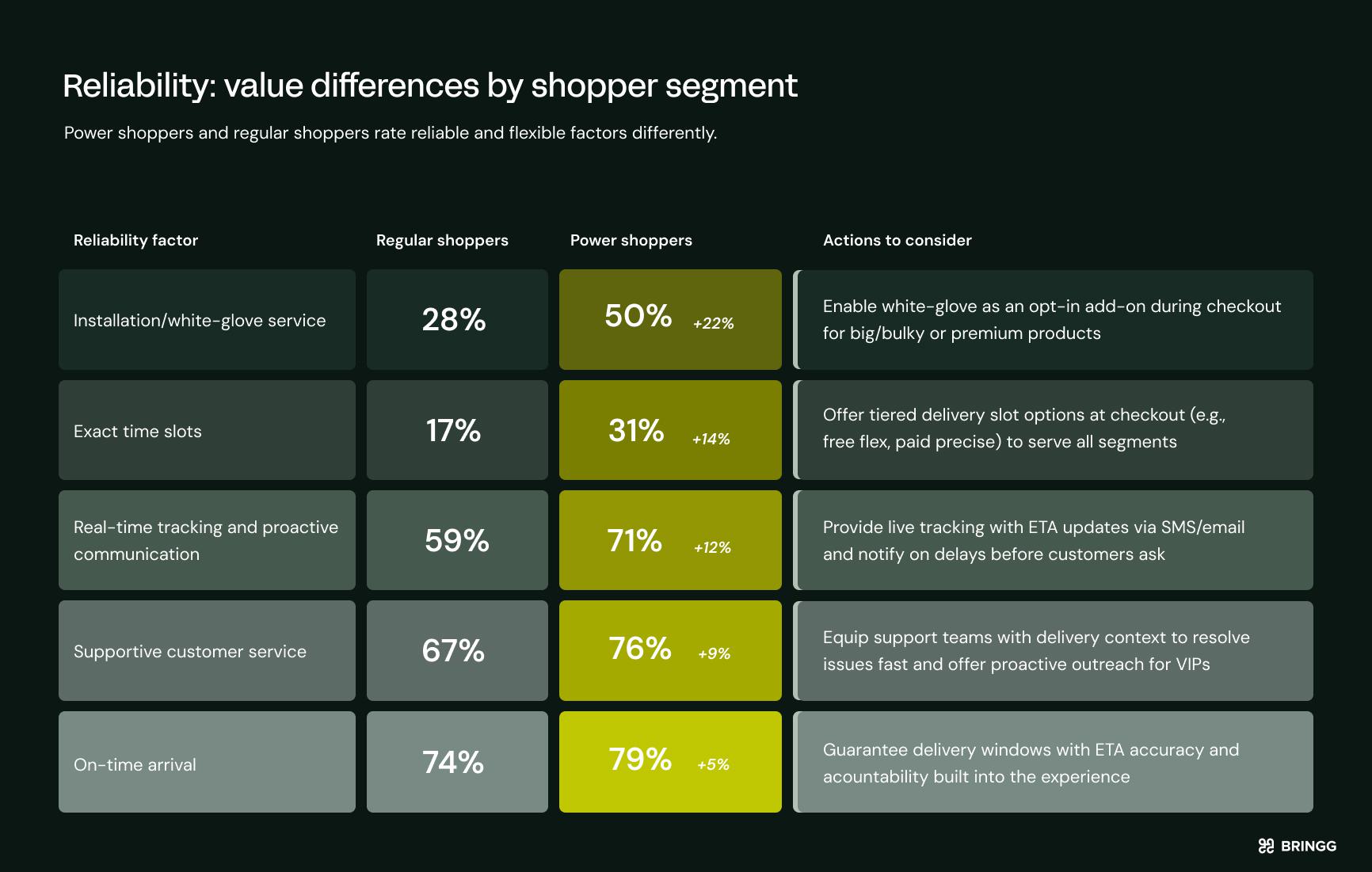
Reliable delivery means an order arrives on time, in good condition, with clear communication if something goes wrong. Every shopper expects that baseline, but power shoppers hold retailers to it more strictly than occasional shoppers do.
Flexibility delivery factors
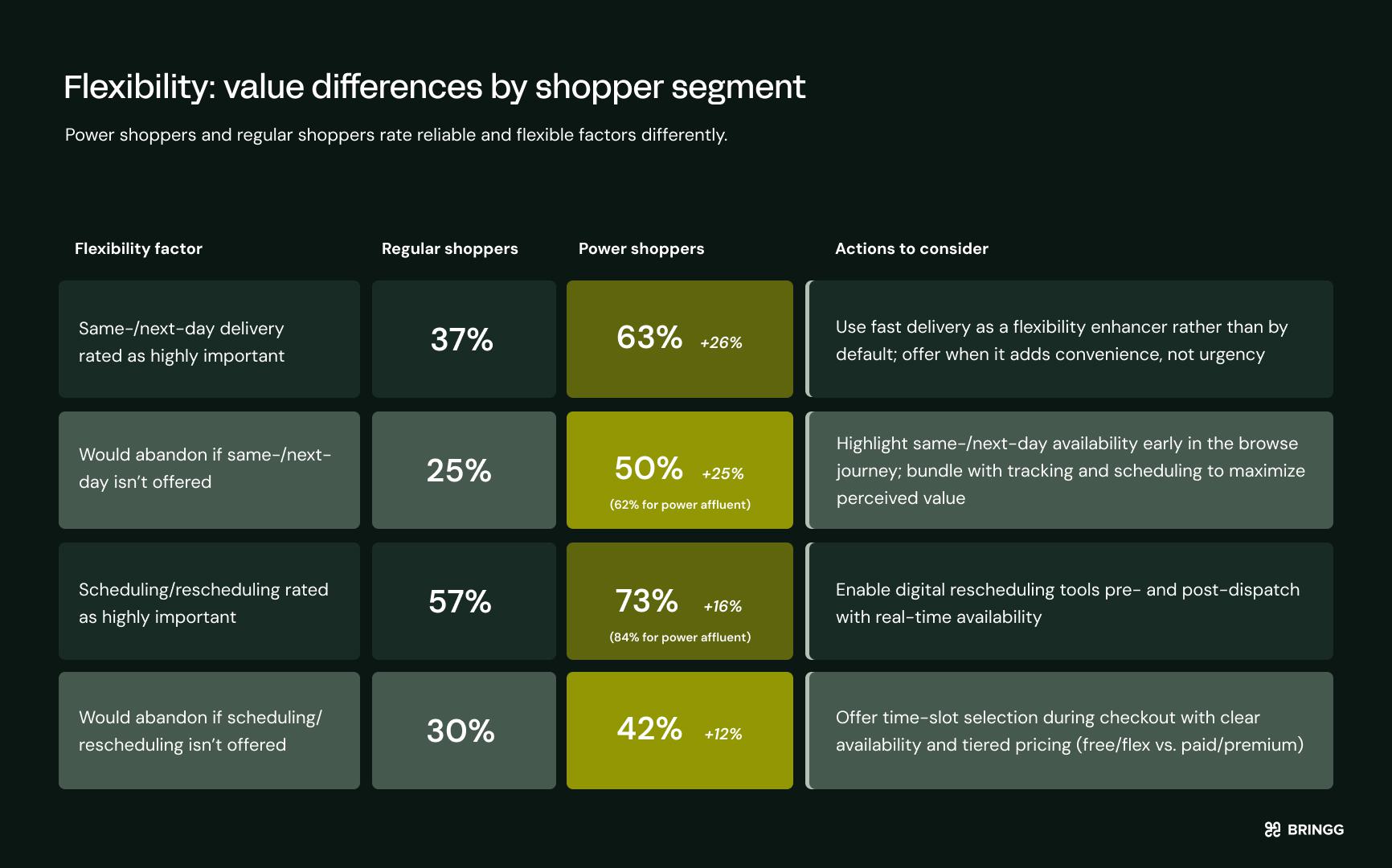
Flexible delivery gives shoppers control over when and how an order arrives—not just how fast. Power shoppers place far more weight on that control than regular shoppers do, and the gap shows up clearly once scheduling and same-day options enter the picture.
Segmented delivery is a competitive differentiator
Retailers don't need to rebuild their entire delivery operation to act on these insights. Most of the framework above builds on data and infrastructure already in place, whether that's order history in a CRM, checkout scheduling tools, or existing tracking pages that just need a rescheduling option added.
Segmenting delivery by shopping frequency can also help prioritize where last-mile investment should go next.
The retailers that pull ahead won't be the ones offering the most delivery options. They'll be the ones offering the right option to the right shopper, at the right point in the journey.
FAQ
What is segmented delivery?
Segmented delivery means adjusting delivery features, communication, and service levels based on how often a customer orders, rather than offering the same experience to every shopper.
How do more frequent shoppers differ from regular shoppers?
Power shoppers (11+ orders/month) rate reliability and flexibility factors like real-time tracking, exact time slots, and rescheduling far higher than regular shoppers (0-5 orders/month). They are also more likely to abandon a brand entirely after a bad delivery experience.
What delivery options matter most to more frequent shoppers?
On-time arrival, proactive communication, self-service rescheduling, and white-glove service for big-ticket items matter more as consumers shop more. Speed alone ranks lower than control and predictability for high-frequency shoppers.
Do free shipping and easy returns still matter?
Yes. Free or low-cost shipping and easy returns are baseline expectations across every segment, with little variation. But they are the entry points and not differentiators.
Does delivery speed matter?
Speed matters, but it's a baseline expectation. Fast shipping remains table stakes for all shoppers alongside undamaged items, easy returns, and low cost/free delivery. These factors carry similar weight regardless of order frequency. Once those basics are met, more regular (0-5 orders/month) and power shoppers (11+ orders/month) rate on-time arrival as highly important compared to same- or next-day delivery.
However, speed still matters more to power shoppers because of the flexibility it offers. 63% rate same- or next-day delivery as highly important, compared to 37% of regular shoppers, and 50% would abandon a cart without it compared to 25% of regular shoppers.
What makes a delivery reliable?
Reliable delivery means an order arrives on time, in good condition, with clear communication if something goes wrong. Expectations rise with order frequency according to Bringg data:
- On-time arrival rated highly important: 74% of regular shoppers (0-5 orders/month) compared to 79% of power shoppers (11+ orders/month)
- White-glove or installation service rated highly important: 28% of regular shoppers vs. 50% of power shoppers
- Exact time slots rated highly important: 17% of regular shoppers vs. 31% of power shoppers
- Real-time tracking and proactive communication rated highly important: 59% of regular shoppers vs. 71% of power shoppers
What makes a delivery flexible?
Flexible delivery means giving shoppers control over when and how an order arrives, not just how fast. The gap between segments is even wider here:
- Same- or next-day delivery rated highly important: 37% of regular shoppers (0-5 orders/month) vs. 63% of power shoppers (11+ orders/month)
- Would abandon a cart without same- or next-day delivery: 25% of regular shoppers vs. 50% of power shoppers
- Scheduling or rescheduling rated highly important: 57% of regular shoppers vs. 73% of power shoppers
- Would abandon a cart without scheduling or rescheduling options: 30% of regular shoppers vs. 42% of power shoppers
Read the full report: Power Shoppers Are the Biggest Loyalty Risk

