
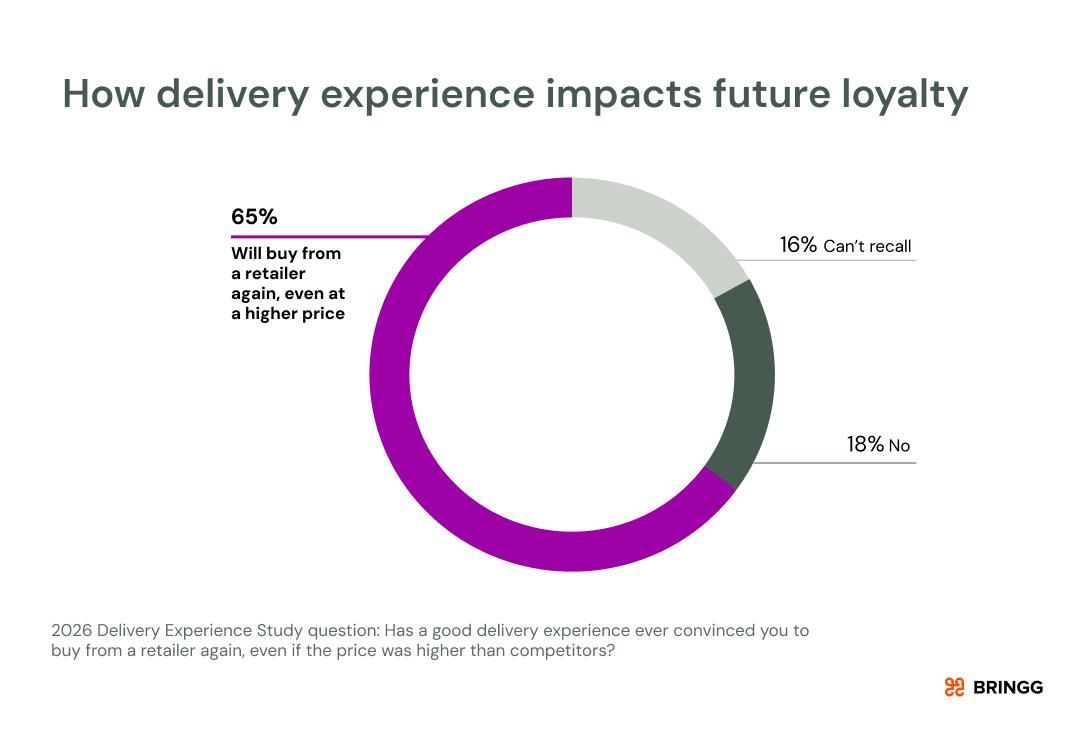
Delivery is now both a loyalty and revenue driver in retail. According to the Bringg 2026 Delivery Experience Survey, 65% of shoppers say a positive delivery experience convinced them to buy from a brand again, even if the price is higher than competitors’. Given that 67% of shoppers said they shop online at least once a week, retailers have ample opportunities to differentiate themselves and secure more customer lifetime value (CLV) with delivery.
But what defines a “great” delivery experience? What delivery elements keep shoppers coming back (especially those who shop most often and have the greatest revenue impact) and let retailers stand out among the competition? It’s not faster or cheaper shipping. The “big three” of Amazon, Walmart, and Costco (the three biggest U.S. retailers) set the precedent for speed and costs and those are foundational expectations. Good delivery today is defined by experiences that are reliable, give the customer flexibility, and create trust.
What defines a great delivery experience?
The 2026 Delivery Experience Survey asked 1,040 consumers what factors contributed most to a great delivery experience. Low costs, package condition, and easy returns ranked at the top but they’re considered table stakes: baseline expectations that determine whether a shopper is willing to buy at all. These fundamentals don’t differentiate a retailer, they simply remove risk from the purchase.
Once these essentials are met, the factors that actually shape the quality of the delivery experience are reliability and flexibility signals.
Reliable delivery experiences: on time, as promised
- On‑time arrival within a clear window
- Live tracking and proactive communication
- Supportive customer service
Flexible delivery experiences: on their terms
- Delivery window selection
- Easy rescheduling
- Same-day or next-day delivery
73% of shoppers say on-time arrival defines a great experience
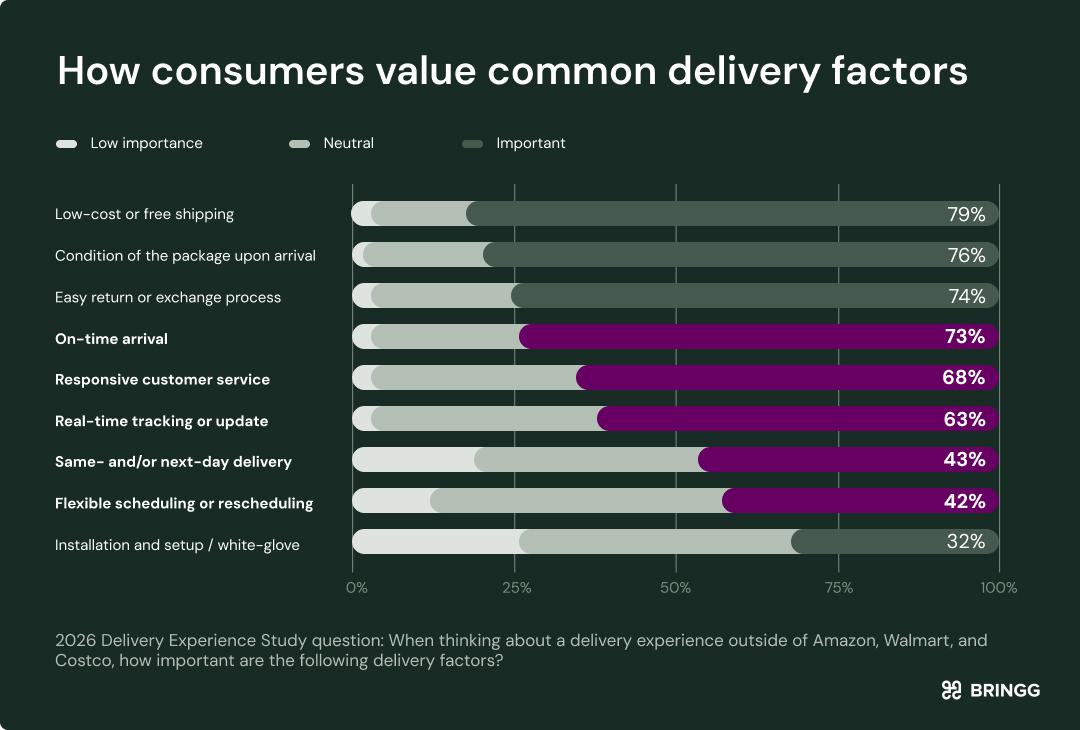
The majority (73%) of shoppers say the reliability of on-time arrival defines a great experience. Flexibility factors of same-day/next-day delivery and flexible scheduling are valued similarly at 43% and 42% respectively. Retailers that invest in these components are well-suited to create the satisfactory delivery experiences that customers reward with repeat purchases.
Explore more insights in the full 2026 Delivery Experience Survey
Great delivery starts before checkout
For most shoppers, a great delivery experience begins the moment they consider buying, long before the order ships. Almost three-quarters (71%) of shoppers think about delivery before they reach checkout, and 41% have delivery expectations before they even start shopping.
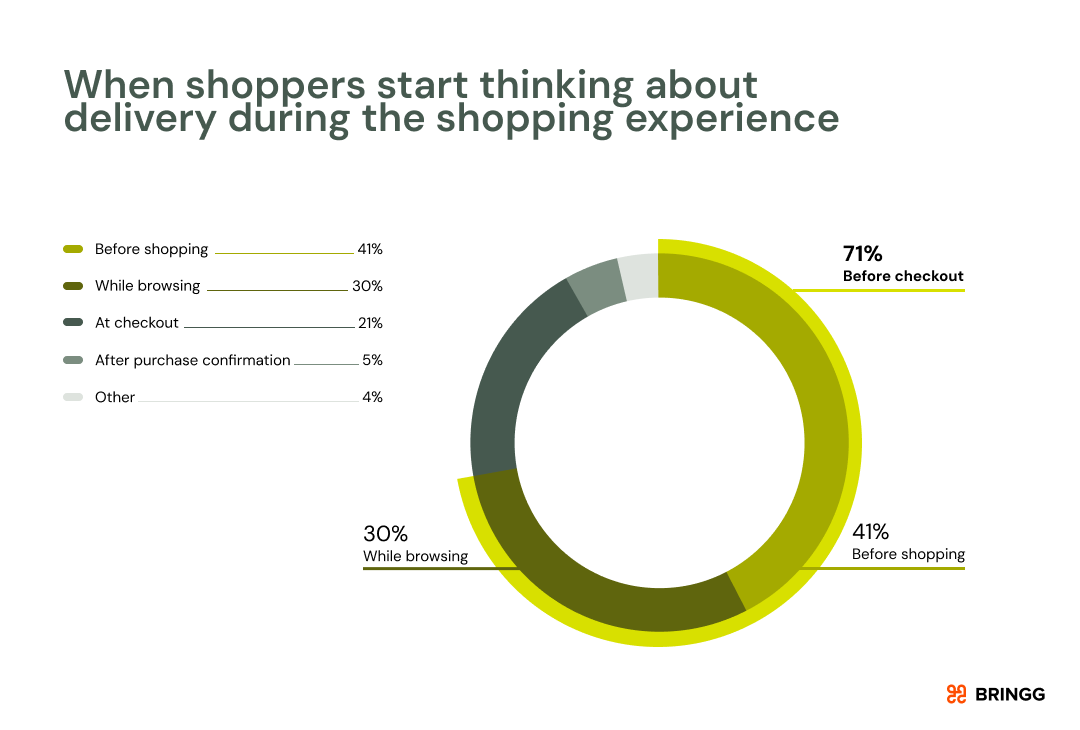
This means reliability and flexibility are now pre-purchase requirements. Shoppers want to see on-time expectations, delivery windows, shipping transparency, and the ability to adjust the experience before they commit. When retailers clearly communicate timing, options, and control upfront, they reduce uncertainty, increase conversion, and set the foundation for a great delivery experience that follows through on the promise.
That pre-purchase mindset is even more pronounced among the highest-value consumers. Power shoppers (consumers who make 11 or more online orders a month) represent 15% of the shopper base but account for an estimated 38% of total orders. Their loyalty is disproportionately valuable and they filter for delivery earlier than anyone else: 53% consider delivery options before they start shopping, compared to 36% of shoppers who make less than six orders a month (aka regular shoppers). Among affluent power shoppers (those earning $150,000 or more annually), pre-purchase delivery consideration jumps to 67%.
A retailer's delivery reputation is a prerequisite for the high-frequency, high-value shopper segment—they've already narrowed their options for where to shop before they see any products.
What high-frequency shoppers expect from delivery
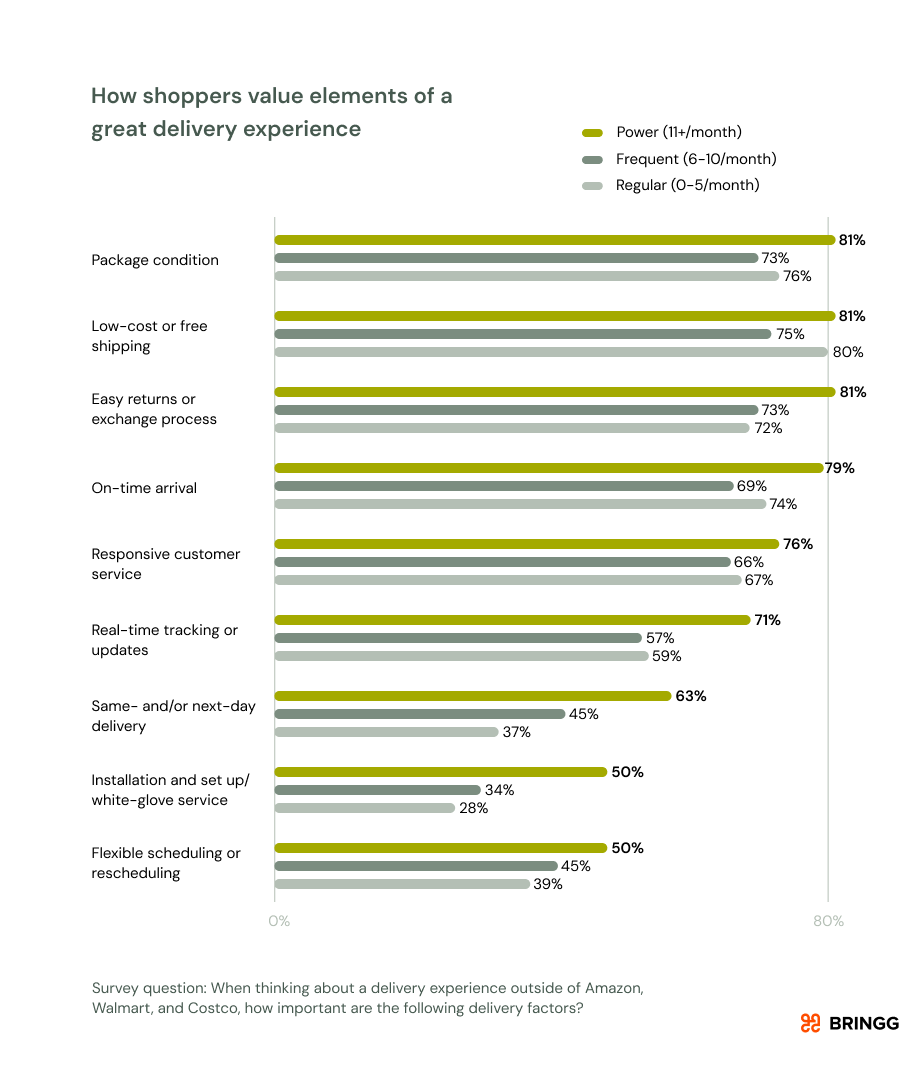
Power shoppers place more orders, encounter more deliveries, and hold retailers to a higher standard across the board. The data shows they value the full delivery stack: package condition, free shipping, and easy returns score as highly for this segment as they do for any other. But the keys to securing long-term loyalty for this valuable cohort sit above the baseline table stakes.
Compared to regular shoppers, power shoppers place significantly more weight on the factors that give them control and visibility:
- 63% value same-day or next-day delivery, vs. 37% of regular shoppers
- 71% value real-time tracking, vs. 59% of regular shoppers
- 50% value white-glove installation and setup, vs. 28% of regular shoppers
Given that 81% of power shoppers say a great delivery experience convinced them to buy from a retailer again, even at a higher price than competitors, the reward for meeting power shopper expectations is greater customer lifetime value.
Great delivery converts to long-term revenue
Across all data, two themes define what converts a good delivery into customer loyalty: reliability and flexibility. Reliable delivery builds confidence that the retailer will follow through on its promise. Flexible delivery builds confidence that the shopper can adapt when plans change.
Together, they create a cycle of loyalty that increases:
- Repeat purchasing
- Willingness to pay more
- Customer lifetime value
- Brand trust and forgiveness
That dynamic is most pronounced among power shoppers. They stay loyal to retailers with reliable and flexible options that surface early and consistently throughout the delivery experience. Delivery-driven loyalty not only protects revenue, it compounds it.
Explore more insights in the full 2026 Delivery Experience Survey
FAQ
Q: What makes a great delivery experience?
A great delivery experience goes beyond fast or free shipping. Low shipping costs, good package condition, and easy returns are baseline expectations. They determine whether a shopper is willing to buy at all—”good” or passable delivery—but don't differentiate a retailer. Reliability and flexibility shape “great” delivery to consumers.
Reliable delivery means the order arrives on time within a clear window, with real-time tracking, proactive communication, and responsive customer support. Flexible delivery means shoppers have control over timing, rescheduling, and speed options. Almost three in four (73%) of all shoppers say on-time arrival defines a great experience, and 65% say a positive delivery experience convinced them to buy from a retailer again, even at a higher price than competitors.
Q: When do shoppers start thinking about delivery?
For most shoppers, delivery is a pre-purchase filter for where to shop. Almost three in four (71%) shoppers think about delivery before they reach checkout, and 41% factor it in before they start shopping. That means retailers have a narrow window to surface delivery promises; they should surface in product pages and search results, not just the checkout screen.
High-frequency shoppers filter even earlier. More than half (53%) of shoppers who order more than 11 times a month (power shoppers) consider delivery options before they begin browsing, compared to 36% of regular shoppers (zero to five orders a month). Among affluent power shoppers (those earning $150,000 or more annually), that figure reaches 67%.
Q: Who are power shoppers and why do they matter to retailers?
Power shoppers are online consumers who place 11 or more orders per month. They represent 15% of the consumer base but account for an estimated 38% of total orders — roughly 10 times the order volume of regular shoppers (who place zero to five orders per month). That concentration of order volume makes their loyalty disproportionately valuable and their churn disproportionately costly.
Delivery performance is a primary driver of both. Power shoppers are more likely to reorder after a great delivery experience and more likely to abandon a retailer permanently after a poor one. For retailers competing outside of Amazon, Walmart, and Costco, this segment represents one of the clearest opportunities to build lasting customer lifetime value through delivery.
Q: What delivery factors matter most to power shoppers?
Power shoppers (11+ online orders a month) value the standard delivery stack of package condition, free shipping, and easy returns score just as much as all other cohorts. But the factors that separate power shoppers from regular shoppers (zero to five orders per month) sit above that baseline in the areas of control and visibility.
According to the Bringg 2026 Delivery Experience Study: Power Shoppers, the gaps are widest in three areas:
- 63% of power shoppers value same-day or next-day delivery, vs. 37% of regular shoppers
- 71% value real-time tracking, vs. 59% of regular shoppers
- 50% value white-glove installation and setup, vs. 28% of regular shoppers
- *see chart above for additional insight
Meeting the baseline expectations for delivery earns consideration. But power shoppers are more loyal to retailers that deliver on control and visibility.
Q: Does a good delivery experience drive repeat purchases?
Yes, and the data is consistent across all shopper segments. According to the Bringg data, 65% of all shoppers in aggregate say a positive delivery experience convinced them to buy from a retailer again, even at a higher price than competitors.
The effect is stronger among high-frequency shoppers. 81% of shoppers who make 11 more orders a month say the same. That 16-point gap reflects how much more delivery weighs in purchase decisions for the cohort with the biggest impact on long-term revenue. For this segment, a great delivery experience builds the kind of trust that sustains purchases over time, even when those shoppers can get a better deal elsewhere.
Q: What is the difference between reliable and flexible delivery?
Reliable and flexible delivery are the two factors that define a great delivery experience above the baseline of cost, condition, and returns.
Reliable delivery means the order arrives on time within a clear window, with full visibility along the way — live tracking, proactive communication on delays, and responsive customer support when something goes wrong. It's the foundation of delivery trust.
Flexible delivery means the shopper has control over how and when the order arrives — time slot selection, easy rescheduling without contacting support, and same- or next-day options. It shifts delivery from something that happens to the shopper to something they can manage.
Together, they form a self-reinforcing loyalty loop. Reliable delivery builds confidence that the retailer will follow through on its promise. Flexible delivery builds confidence that the shopper can adapt when plans change. Retailers that deliver on both create the conditions for repeat purchases, higher willingness to pay, and stronger customer lifetime value.


