
Every department along the order lifecycle can hit 100% of its own metrics and still fail. The warehouse picks correctly. The carrier ships on time. The order arrives as promised. But the customer is still unsatisfied.
This isn’t an edge case. It's a structural problem with how most retailers and logistics providers measure last-mile performance.
Paula Natoli, director of global strategic industries, supply chain and logistics at Google Cloud, has spent her career at the intersection of supply chain and technology, examining these structural problems firsthand. She started at Blue Yonder, working directly with retailers and logistics providers on planning and execution. At Google Cloud, she now focuses on applying AI and data infrastructure to solve complex supply chain challenges.
On this episode of Deliver: The Last-Mile Performance Podcast, hosts Bringg CEO Guy Bloch and Sales Engineering Lead Raquel Zanoni sit down with Paula to break down why functional KPIs obscure the customer experience, where data most commonly breaks down across the order lifecycle, and what it takes to shift from reactive to proactive operations.
Key takeaways
Functional KPIs create a false picture of last-mile performance
- The shift from functional KPIs to experience KPIs is the core fix. Functional metrics measure what each department did. Experience metrics measure what the customer felt.
- Every team along the order lifecycle can hit 100% of its own targets and the customer still churns. That gap is structural, not accidental.
- Organizations that measure departmental success in silos can look healthy on every dashboard, but inherently fail the customer at the doorstep.
Data breaks down at handoffs, and the causes are predictable
- Timing mismatches and data-mapping inconsistencies are the two most common failure points across the order lifecycle. Both are identifiable before they cause customer-facing damage.
- Every handoff, from retailer to warehouse to carrier, runs on different systems with different identifiers. Without synchronization across those systems, breakdowns are inevitable.
- Phantom inventory, mislabeled shipments, and address validation failures all trace back to data breaks that occur before the order ever leaves the building.
Organizational silos undermine performance even when the technology works
- Departments that optimize for their own metrics will fall short on the customer experience, regardless of how well the underlying tech performs.
- The problem exists at the technological and cultural level. Fixing the data layer without aligning the organizational structure around shared goals is a dead end.
- Shared KPIs oriented around the complete customer journey, not departmental performance, close the gap.
Businesses that skip the data foundation and jump to AI underperform
- The retailers and logistics providers seeing results from AI investment built a clean, connected, governed data foundation first. Those that didn't are still waiting for AI to deliver.
- That foundation requires integration of data semantics across systems, clear governance, and full inventory visibility across the network.
- AI applied to flawed data produces wrong answers that are just faster and more confident, which makes them more dangerous.
Catch a problem before the customer does and change the loyalty equation
- Retailers that identify a delivery failure hours before it reaches the customer, and contact the shopper proactively, retain customers that reactive operations lose.
- A unified data layer makes it possible to catch and resolve issues 48, 24, or five hours before they arrive at the door and before the customer calls about their order.
- The loyalty gap between leading retailers and the rest is built in that window.
Where does data most commonly break down across the order lifecycle?
The order lifecycle is not a single transaction in Paula’s eyes. It spans multiple systems, multiple organizations, and multiple handoffs, each one a potential point of failure. The most common causes are timing mismatches, where data between systems falls out of sync, and data mapping issues, where the same item is identified differently across platforms. These are not just technical problems. They have direct customer consequences.
"Each step of that process independently has its own challenges,” Paula said. “Where do the data breaks occur? First and foremost, there's a lack of synchronization and timing. Something gets placed, it's not synchronized fast enough with another step across the process. Now you're looking at two different systems of record.
"If you don't have the right synchronization across timing or across the underlying data management, each one of those just presents more and more opportunities for data break. Phantom inventory is a prime example. You think you have that inventory available to allocate and you don't. You're just losing the order," Paula said.
The downstream cost compounds quickly. Guy pointed out that some companies are running redelivery rates of 10 to 12% across millions of deliveries a year. At that scale, every percentage point represents thousands of customers who weren't home because the delivery arrived outside the promised window.
"When you look at millions of deliveries a year at scale, that means so many customers," Guy said. “Either the delivery arrived earlier than promised or later than promised. They were not home to take it. And they are not coming back.”
How do KPIs need to evolve as customer expectations increase?
Most retailers measure last-mile success the way it's always been measured: on-time rate, pick accuracy, cost per delivery. Those metrics are not wrong. They just don't tell you whether the customer is satisfied. As order complexity grows and consumer expectations rise, the gap between what the dashboard shows and what the customer experiences keeps widening.
Guy also contextualized a key shift in the last mile moving from the basement to the boardroom. The C-suite is now focused on it as a competitive differentiator, not just a cost center. That elevation changes what KPIs need to measure and who they need to answer to.
"Just as our global supply chains are getting more and more complex, the corresponding KPI metrics and the expectations of all of us as consumers are also much higher and more complex," Paula said.
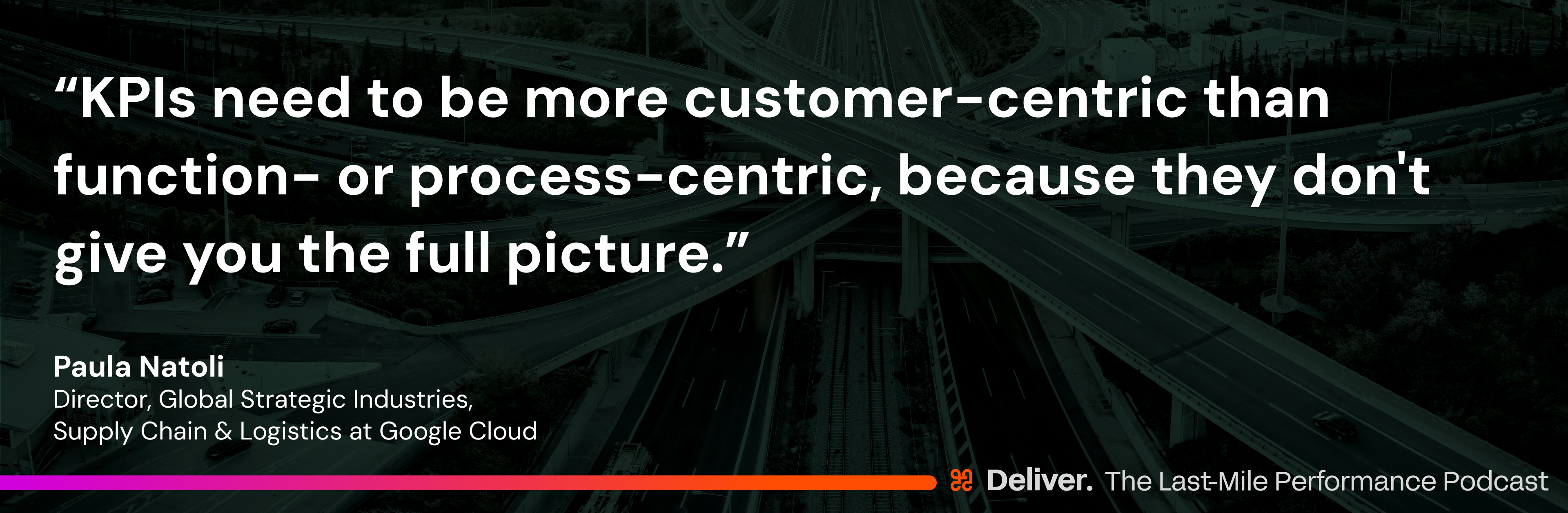
“KPIs need to be more customer-centric than function- or process-centric, because they don't give you the full picture. They give you just your portion of it. If the customer's not happy, the whole process failed. Along that journey, each team can say, 'I did my job.' But in the end, how satisfied was the customer? Zero."
Do organizations undermine their own performance by operating in silos?
Silos are still a widespread problem, and they exist at two levels: technology and culture. Even when systems are integrated and data flows correctly, if teams are measured and rewarded independently, they will optimize for their own numbers. The result is a supply chain that looks healthy from every department's dashboard and still fails the customer.
"Every organization is developing OKRs for the year, and each team has metrics within their own world they're working to optimize," Paula said. “Merchandising and sales want to sell. On the supply chain side, if you didn't order enough inventory, you can't fulfill it. Those need to be synergized. That's not even getting all the way through to the last mile. That's a failure upfront with those levels of silos.
"The data is flowing beautifully. We have it integrated, we have it connected. But organizationally, if we are not working towards that complete total customer experience, we are going to miss it. We end up safeguarding ourselves.
"Whether or not we have the right technology in place, if we are not organizationally working towards those common goals, there's still going to be that type of failure," Paula said.
What does “good” look like for organizations with strong data maturity?
The retailers Paula points to as best-in-class are not the ones with the most advanced AI implementations. They are the ones that did the foundational work first: connecting systems, standardizing data semantics, and establishing governance before layering in any new technology. That sequence matters.
"The best organizations I see are investing in building out that data foundation. That means integration of data semantics between systems, aligning KPIs, establishing governance around data. Then they layer in AI for proactive exception management."
A grocery retailer Paula worked with faced a problem most operators don't frame as a data problem: they couldn't answer a basic question with confidence. How much inventory do we actually have, and where is it right now?
The answer lived across multiple systems that didn't talk to each other: supplier orders upstream, inventory in transit to the warehouse, and shipments moving to individual stores. Each stage had its own data source and none of them produced a single, reliable number.
The investment wasn't in AI, routing optimization, or demand forecasting. It was in connecting those systems well enough to get a truthful inventory picture across the full network. That became the foundation everything else was built on.
Paula also stressed that winning organizations have "data champions who are helping to map all of that out, because that is going to be the solid foundational structure by which we're going to invest in and utilize all this new technology that's coming."
What are the most effective ways to address fragmented data across systems and partners?
The answer starts with mapping the full data flow and identifying where the critical break points are before they cause failures. From there, it requires technology that communicates across a diverse ecosystem, not proprietary systems that create new barriers. AI can also identify where data is already flawed and address the problem upstream rather than after the fact.
"We have to think about mapping the entire flow. As you identify those points, you see where the critical potential break points are. Having and investing in a data foundational strategy is going to become critical. It keeps us out of our individual silos," Paula said.
"It's almost like a chicken and the egg. We have flawed data, so we can't use AI. Well, maybe we can also use AI to more proactively identify where we have flawed data," she continued.
As retailer and carrier ecosystems grow more diverse, the data fragmentation problem grows more intense. The organizations that get ahead of it will invest in technology built on open systems that communicate across partners rather than proprietary architectures that create new barriers every time a new player is added to the network. Paula pointed to Google's Universal Commerce Protocol, announced at NRF, as an early signal of where this is heading: a world where not just systems but AI agents need to interoperate across the full commerce ecosystem.
How does data maturity create a competitive advantage in last-mile delivery?
A unified data layer allows organizations to identify problems hours or days before they reach the customer, which changes the trajectory of the experience entirely. Instead of waiting for a complaint, the retailer reaches out first with context and a resolution. That shift from reactive to proactive creates a loyalty revenue gap between leading retailers and the rest of the market.
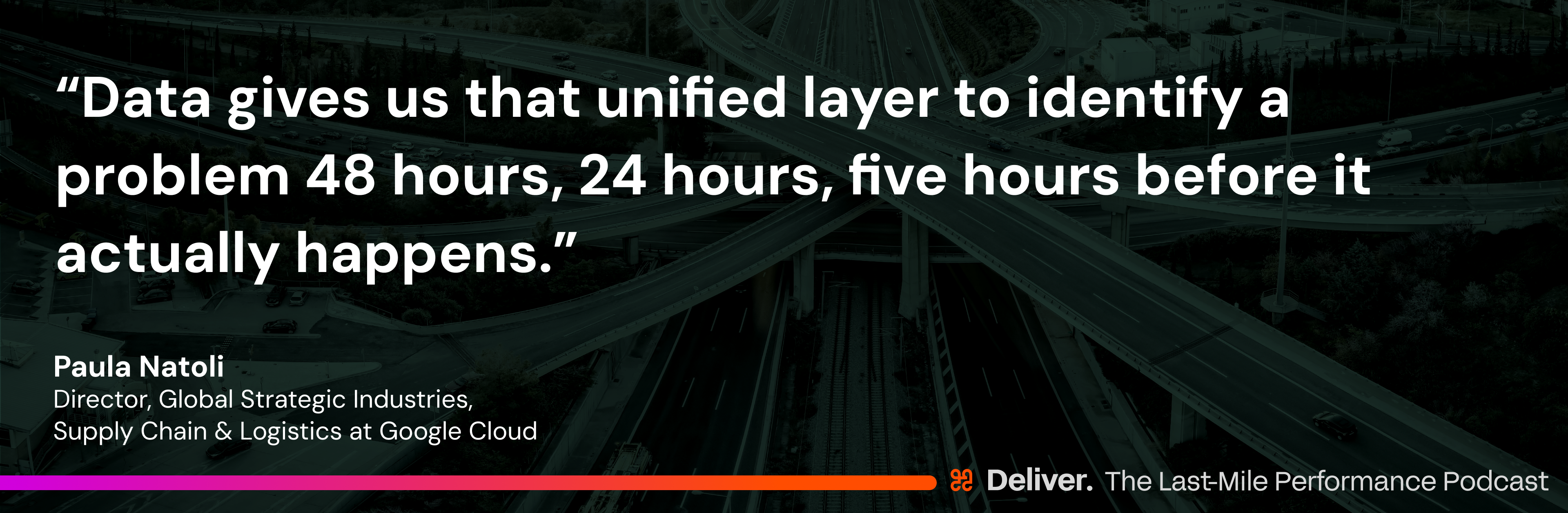
"Data gives us that unified layer to identify a problem 48 hours, 24 hours, five hours before it actually happens. And now you take a different trajectory,” Paula said.
Raquel recounted a bad last--mile experience that sits at the center of this argument. She entered the wrong city and state at checkout. The retailer's eCommerce site had no address validation and the order shipped anyway. She only discovered the problem two days after the expected delivery date when she looked up the tracking herself.
Paula's point is that the data to catch that failure existed somewhere in the system. The package was in processing limbo but the address mismatch could have been corrected. A well-connected data layer could have surfaced the error, particularly within a process designed to act on it before the customer noticed.
That's Paula's practical case for data maturity: not a dashboard improvement or an efficiency gain, but the difference between a customer who reaches out frustrated and one who receives an apology and a discount before they ever have to ask.
"What if we interject AI into the process so the retailer or logistics provider identifies that problem, fixes it, and contacts you along the way: 'I'm so sorry, here's 10% off your next order.' How different would that experience have been?” she said.
What is the most exciting thing about the future of the last-mile?
The speed and reliability improvements of the last decade, faster windows, better tracking, same-day options, are not the ceiling. Paula sees AI connecting both sides of the commerce experience. It will fulfill orders faster and personalize what gets offered before the customer even knows they want it. The front end and the back end—discovery and delivery—will start operating as one system.
"Where we're going to see everything with AI come together is not just fulfilling the order, but helping you find what you want, or what you don't even know you want or need," Paula said. "There's going to be so much more personalization, and that personalization is going to allow us to convert and deliver even faster."
What is one piece of advice for leaders looking to improve last-mile performance?
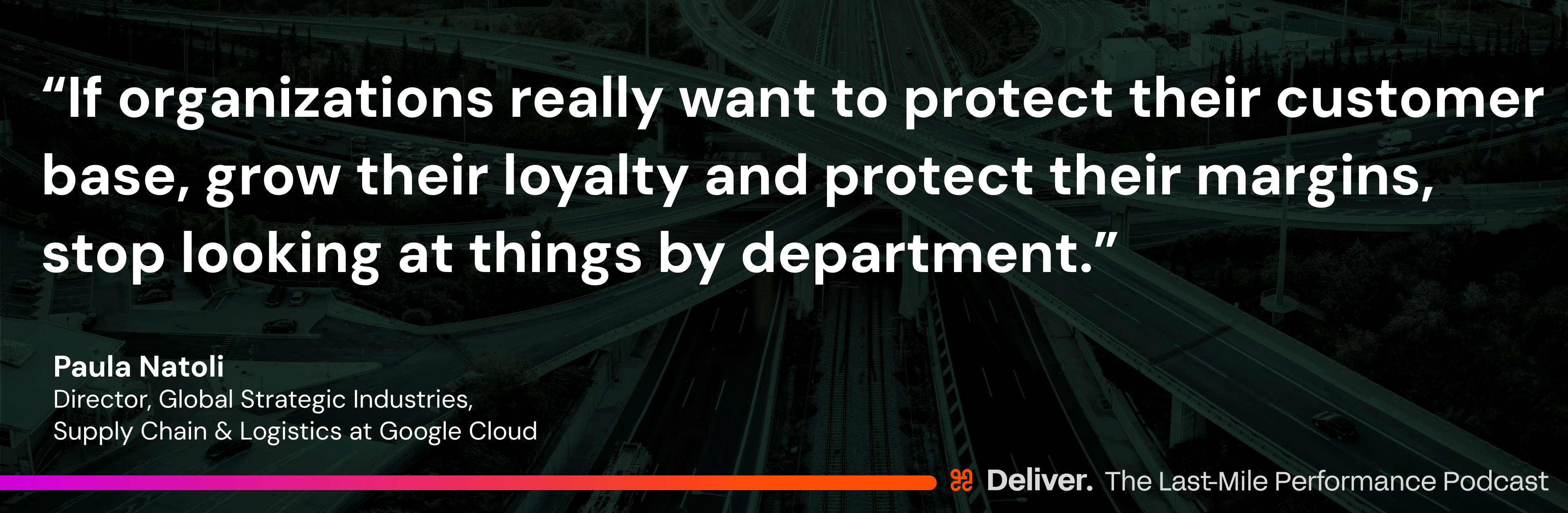
"If organizations really want to protect their customer base, grow their loyalty and protect their margins, stop looking at things by department," Paula said. "Start managing the entire data thread, because that data thread is what drives the entire experience. A perfect pick in the warehouse is still a failure if it's the wrong item or the wrong door."
Paula said the last mile is the final touchpoint between a retailer and its customer, and the experience it produces determines whether that customer comes back. That reframe makes last-mile performance a brand strategy question, not a logistics operations problem.
She also urged businesses to break down the silos, not just on the technology side but on the organizational and cultural side to create the unified data layer needed for the best customer experience.
Catch up on each episode of on Deliver: The Last-Mile Performance Podcast


