There's a lot to learn from building a last-mile operation from scratch at one of the UK's largest grocers. Founding an operation like that can teach someone a lot about what a successful delivery program costs to run, how long it takes to see impact, and how far upstream a doorstep failure actually starts.
Chris Conway, senior vice president and general manager for enterprise at Bringg, founded Co-op's online food business and scaled it to reach 86% of the UK population. Today he sits on the other side of the table, helping retailers and logistics providers across EMEA and North America build and scale their own last-mile operations.
On this episode of Deliver: The Last-Mile Performance Podcast, hosts Bringg CEO Guy Bloch and Sales Engineering Lead Raquel Zanoni sit down with Chris to unpack what two decades of building delivery operations actually reveals. He discusses why doorstep failures trace back to upstream system gaps. He also explores how to structure a business case that earns organizational buy-in, when to use own fleet versus third-party carriers, and why retailers who treat delivery as a cost center are falling further behind than they realize.
Key takeaways
Delivery can differentiate the retailers that are early adopters
- Delivery earns C-suite investment when a leader inside the business reads the market signal early and builds the case before competitors make it undeniable.
- Chris's experience across Asda, Morrisons, and Co-op showed this consistently. Tesco captured close to 40% of the UK online grocery market because someone made the call before the rest of the market felt the urgency. The retailers that waited for external pressure to force the decision spent years catching up from a more expensive position.
- By the time the competitive threat is obvious to everyone, the window to lead has already closed.
Last-mile operations requires variable costs and sequential stage gates, not large upfront bets
- The most effective path to organizational buy-in is a business case built around variable costs that scale with order volume instead of fixed capital commitments.
- Co-op went live in under six months, launching from 30 stores using existing fleet assets and variable store-colleague hours.
- Asking for the whole journey in one capital request is the most common reason delivery programs stall. Start lean, prove the model, earn the right to scale.
Doorstep failures almost always trace to a system gap
- When delivery fails at the front door, the cause sits upstream in a process, system, or decision that no one is reviewing because all attention is on the visible failure.
- Treating symptoms with more capacity, more drivers, or manual intervention is expensive and temporary. Run a post-mortem on every significant failure to identify the root cause, and fix the system rather than the symptom.
- Operators who build that discipline stop paying for the same failure repeatedly. Those who don't will fix the same doorstep problem next week, next month, and the month after.
KPIs have to track current performance and signal where to focus next
- A measurement framework anchored only to operational efficiency misses the signals that matter most to long-term business health. KPIs need to do two jobs at once.
- Co-op's framework evolved from cost and operational metrics toward customer behavior metrics as the operation scaled. By the time the business had grown significantly, every internal meeting opened with one question: what customers did we lose and why?
- Operators that stay anchored to operational KPIs past the early launch phase are measuring the wrong thing.
Adding fleet capacity is rarely the right fix for failing delivery performance
- When delivery performance declines, the instinct is to throw capacity at it. In most cases, capacity is not the constraint.
- Picking accuracy, routing discipline, and real-time customer communication consistently outperform capacity additions in their impact on satisfaction. More drivers do not fix a broken substitution process. More vehicles do not fix a picking error.
- Operators who chase capacity before fixing system integrity spend more to get the same result.
Retailers that treat delivery as a cost center delay the learning that makes operations financially sustainable
- Minimizing delivery investment defers the operational learning across cost per drop, route efficiency, and carrier relationships that determines long-term unit economics.
- Every month where delivery is treated as overhead is a month a competitor is compressing those costs and building loyalty that compounds.
- In two years, retailers who invested in delivery as a brand asset will be measurably ahead on customer frequency, retention, and competitive relevance.
Catch up on every episode of Deliver: The Last-Mile Performance Podcast
How does delivery become a strategic priority?
In the mid-2000s, UK grocery was still debating whether online delivery was worth the investment. Capital requirements were steep, last-mile costs were high, and consumer demand was still maturing. Most retailers waited. Tesco didn't, and Chris watched from inside Asda as Tesco captured close to 40% of the UK online grocery market as a result. The rest of the market eventually caught up, but catching up is a more expensive position than leading.
Chris said that pattern repeated itself across every market he worked in. Delivery earns C-suite attention when consumer behavior makes it impossible to ignore. But the retailers who built lasting advantages were the ones with someone inside willing to act before the pressure became undeniable.
By the time Chris arrived at Co-op in 2018, the dynamic had shifted. Consumer demand was no longer speculative—it was proven and the C-suite knew delivery was a strategic priority
"I think delivery became a C-suite priority when it became the customer's priority," Chris said. "Consumers have been trained. If you look at the likes of Amazon, they've really changed the customer expectation from any retailer. Delivery becomes not an addition to your business, but an integral part of how you deliver your brand to consumers.
"As soon as the C-suite started seeing market share shift and people changing the way they shop from physical outlets into other retailers through delivery, all of a sudden it becomes an economics problem and a P&L problem. And as soon as that happened, you didn't need to force anybody. It was forced upon you."
What does it actually take to build a last-mile operation from scratch?
Chris said most organizations underestimate what standing up a delivery operation requires, not just in capital, but in timeline, organizational patience, and the discipline to treat launch as a beginning rather than a destination. The operators who get this right structure the process so the organization says yes to each stage, not the whole journey at once.
When Chris joined Co-op in 2018 the business had no online presence and some internal scar tissue from a previous failed attempt. The board was understandably cautious about investment. His response was to spend the first three to six months listening to colleagues, customers, suppliers, and consultants who had been involved in the prior attempt before proposing anything.
What emerged was an asset the business had been sitting on without recognizing it: over 2,500 stores spread across the UK, geographically positioned exactly where customers lived. That footprint made Co-op unusually well suited for quick commerce, a model that the broader UK grocery market (which was oriented around large-basket scheduled delivery) had not yet built toward.
The business case was structured almost entirely around variable costs built to scale with order volume rather than requiring heavy upfront capital. Picking used existing store colleagues on variable hours. Delivery used a mix of third-party providers and a legacy home delivery fleet that was underutilized. The technology build started in October 2018 and the full operation went live to customers in March 2019 with 30 stores across London and Manchester.
"Going live wasn't the finish line," Chris said. "It was the starting line. What we did then is closely track results against every assumption in the business case. As those numbers firmed up, we started to hit our internal stage gates and the business gained confidence every week.
"When people ask me what it actually takes to build something like this, the honest answer is it isn't a single big bet. It's about structuring things so the organization has to say ‘yeah’ to the next stage, not the whole journey. You start lean, you prove the model, then you scale with confidence."
Raquel pushed on the role of the business case itself, having seen retailers arrive with long functional requirements lists rather than a financial framework. Chris's answer was that the business case was the language the organization needed to say yes, but the real work started with the customer.
"We gave the impression internally that we started with the business case, but the reality was when we got in a room and started thinking about the proposition, it started with a customer," he said.
What makes quick commerce operationally different from scheduled delivery?
Quick commerce is not a faster version of standard grocery delivery. It requires a fundamentally different technology stack, a different customer experience design, and a different tolerance for uncertainty in demand forecasting. Most of the established playbooks from scheduled delivery don’t transfer.
When Co-op launched its quick commerce capability, there was almost no comparable data to point to. That was pre-COVID, before quick commerce was a recognized category. Every competitor was focused on large-basket scheduled orders. Chris was asking the organization to back something that couldn't be benchmarked against anyone else in the market.
The technology decisions followed those realities.
"It would have been easy to build it on the legacy systems that we already had, but the legacy systems simply weren't designed for immediacy,” Chris said.
Rather than adapt what already existed, the team built new systems and new partnerships from the start. They designed the technology around the customer's mission rather than the other way around.
The customer experience design was an equally deliberate departure. Chris said grocery websites spent years training shoppers to browse, add items, and plan their week. Quick commerce requires the opposite: speed, simplicity, and a frictionless checkout. Co-op designed the experience to feel closer to ordering a takeout than doing a weekly shop.
"Immediacy is about speed and simplicity," Chris said. "We deliberately designed the UX to feel less like a traditional grocery shop and more like ordering pizza. Fewer items, faster decisions, a frictionless checkout—a quite conscious departure from what customers were used to.
"When we launched in 2019, no grocery retailer was sharing live order tracking. For us it was a requirement from day one. We wanted customers to be able to track their order in real time, the same way they track an Uber or Deliveroo order. We didn't just match what the market was doing. We set a new standard."
How should last-mile KPIs evolve as a delivery operation scales?
For Chris, the metrics that serve a new delivery operation well at launch are not the ones that dictate what matters at scale. A measurement framework has to grow with the business and the most meaningful evolution is the shift away from operational metrics toward customer behavior metrics.
Co-op started with the fundamentals: sales, basket size, margin, picking cost, cost per drop. Alongside those, the team tracked time on site closely, because the quick commerce proposition was built around speed and simplicity. If customers were spending too long on the platform, something in the design wasn't working.
On the last-mile side, the headline metric from launch was total time from order placement to doorstep. Co-op targeted under 90 minutes initially, and broke that total into component parts like pick time, wait time, and delivery time to identify exactly where problems sat in the journey. As the operation scaled and confidence in the model grew, that target was tightened to under 60 minutes.
"KPIs have to do two jobs at once," Chris said. "They need to track where the business is working and tell you where to focus next. The measurement framework was never static. It grew and matured as the business did.
"The evolution I'm probably most proud of was the shift toward customer metrics. We moved beyond operational KPIs and started looking much more closely at customer behavior: when they order, what they order, how frequently. We segmented customers into groups and tracked churn closely. We started every single meeting with: ‘What customers did we lose? Why did we lose them? Why have they churned?’
“It wasn't sales first. It wasn't cost first. It was lost customers first. Because if you understood why someone stopped ordering, you understood exactly what you needed to fix."
Why do delivery failures start long before the doorstep?
A wrong item, missed window, and distressed customer are examples of delivery failures that almost always originate upstream in a system gap, a process assumption, or a decision made days earlier. Operators who treat the symptom without finding that root cause will fix the same problem repeatedly.
During Co-op’s first year of quick commerce, Chris said a customer placed an order late in the evening that was clearly a family meal built around ground beef/beef mince. When the store colleague went to pick the order, the beef was unavailable. A substitution engine suggested pork mince, which was a reasonable alternative by any standard grocery logic. The driver delivered but the customer was deeply upset because her religious beliefs meant she could not eat pork. The substitution was not just inconvenient but genuinely distressing and since it was late in the evening, there was no easy alternative to source.
Fortunately, the store manager acted quickly and sourced beef mince from a nearby store and got it delivered. The customer received what she needed, but her order frequency dropped afterward. The failure had been recovered but not undone.
When Chris traced it back, the root cause had nothing to do with the colleague's judgment in the moment. The decision to suggest pork mince was exactly what the system was designed to do. The gap was in the substitution algorithm itself—it had no awareness of religious dietary requirements or allergies. Chris said that discovery prompted nine to 12 months of work to build those requirements into the substitution logic and add front-end prompts allowing customers to flag dietary restrictions before ordering.
"The front-door failure was a distressed customer at 9pm," Chris said. "But the cause was a gap in the substitution algorithm. That's how far back it usually sits. The failure isn't at the customer's doorstep. It's somewhere back in the store or back in your system.
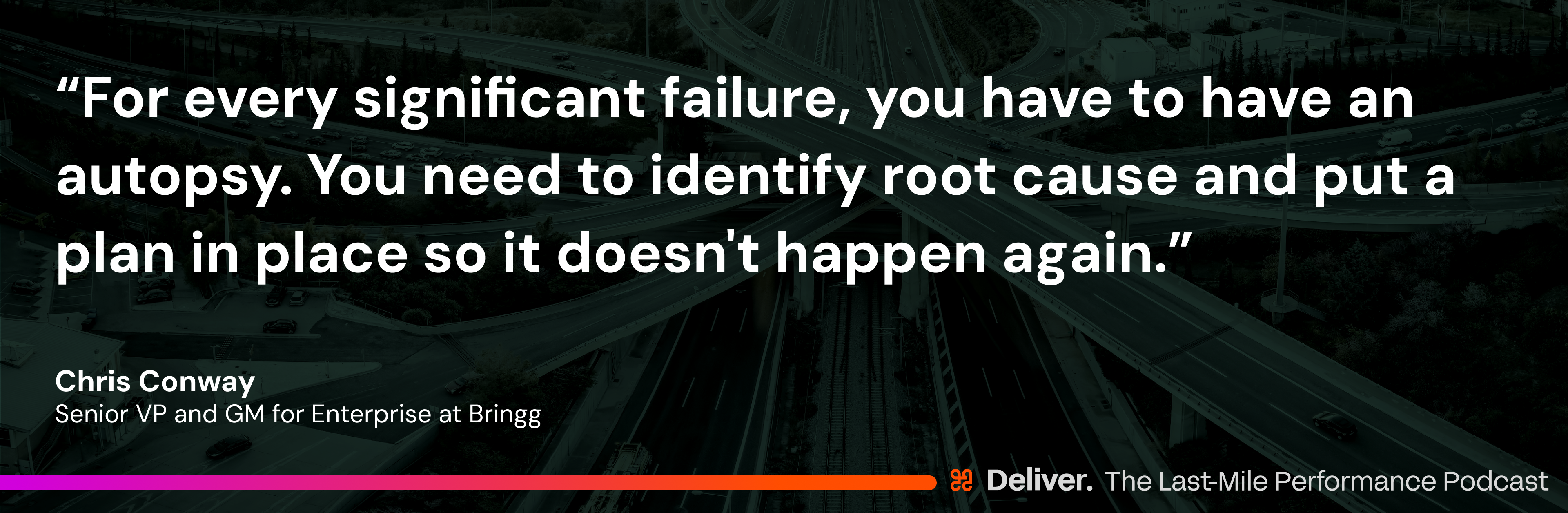
"Every significant failure, you have to have an autopsy. You need to identify root cause and put a plan in place so it doesn't happen again. The risk in any operation is that once a customer is appeased and the complaint is closed, the energy dissipates and nothing changes. Treating symptoms is expensive and endless. Fixing causes is how you actually improve."
How should retailers decide between using their own fleet or third-party carriers?
The assumption most operators carry into this decision is that a branded fleet produces a better customer experience. The data Chris collected at Co-op said otherwise. HIs findings changed how the entire question was framed internally and shifted it from a customer decision to a business decision.
"My going-in position was that our own fleet would be the best customer experience because they'd have the uniforms, they'd have the branded fleet,” Chris said. “And actually that wasn't true. It didn't come through in the customer satisfaction scores or the on-time metrics."
He said customers who had spent years receiving deliveries from Amazon and other platforms had been trained to expect different drivers at the door. The presence of a branded vehicle and a uniformed driver did not produce the loyalty lift the internal assumption predicted.
Once the C-suite accepted that finding, the fleet-versus-carrier question became a cost and coverage optimization problem rather than a brand protection problem. Co-op retained its own fleet where volume was high enough to keep drivers fully scheduled and keep fixed costs justified.
Third-party carriers absorbed demand peaks and troughs, which are tough to model in quick commerce where immediacy makes forecasting inherently less precise. In high-density urban markets like central London, Manchester, and Birmingham, third-party coverage was extensive enough that shifting volume there produced a real cost benefit and allowed Co-op to reduce and renew its own fleet at lower cost with zero-emission vehicles. Owned fleet was retained for rural areas and geographies where third-party coverage was thin or expensive.
"Once we realized that, the customer end of it stopped being a concern,” Chris said. “Which made the decisions about the business benefit much clearer. I'd encourage anyone out there not to be worried about third-party carriers. The carriers I've worked with have been determined and really focused on the customer. Start there, and then the structure of your delivery mechanism becomes a business benefit rather than a customer compromise."
What happens to retailers who underinvest in last-mile delivery?
Chris said the retailers who minimize delivery investment today are not just accepting lower satisfaction scores. They are deferring the learning that determines whether their operations are financially sustainable at scale. Retailers that enter the market late inherit a cost structure their competitors already optimized years earlier.
"The sooner you get into delivery, the sooner you start optimizing it,” Chris said. “The learning curve is real. Your cost per drop, your route inefficiency, your carrier relationships — you can't shortcut that experience. The cost center mindset doesn't just hurt your brand. It delays the learning that eventually makes the operation financially sustainable."
The doorstep is also where brand perception is formed for customers who shop online. Every interaction at that moment is a brand moment. Retailers who understand that will build loyalty through the delivery experience. Those who don’t will fulfill transactions and lose customers quietly, often without knowing why.
"We know customers are increasingly choosing online over physical retail," Chris said. "That shift shows no signs of slowing. If you're treating delivery as a cost to be minimized rather than a channel to be invested in, you're essentially choosing to be less accessible to your customers over time. In two years that will show with declining relevance and lost frequency from customers who simply moved to a competitor who made it easier.”
How can businesses improve last-mile performance?
"Treat it as a strategic pillar," Chris said. "Last mile delivery is not a support function. It is not a cost line. It is a core part of what makes your business successful.
"Done right, last-mile delivery can add millions to your bottom line. It builds loyalty, it drives frequency, it differentiates your brand. Done wrong or done half-heartedly, it costs you in refunds, in lost customers, in brand damage and it takes years to recover from. The leaders who win are the ones who make that decision early, commit to it fully, and never stop treating it like it deserves their best thinking and their closest attention."
Catch up on every episode of Deliver: The Last-Mile Performance Podcast


