
Which shopper is more expensive to lose: one who shops five times a month or 11+ times a month?
Despite the obvious answer, many retailers fail to tailor delivery experiences to higher-frequency shoppers, and they put significant recurring revenue at risk.
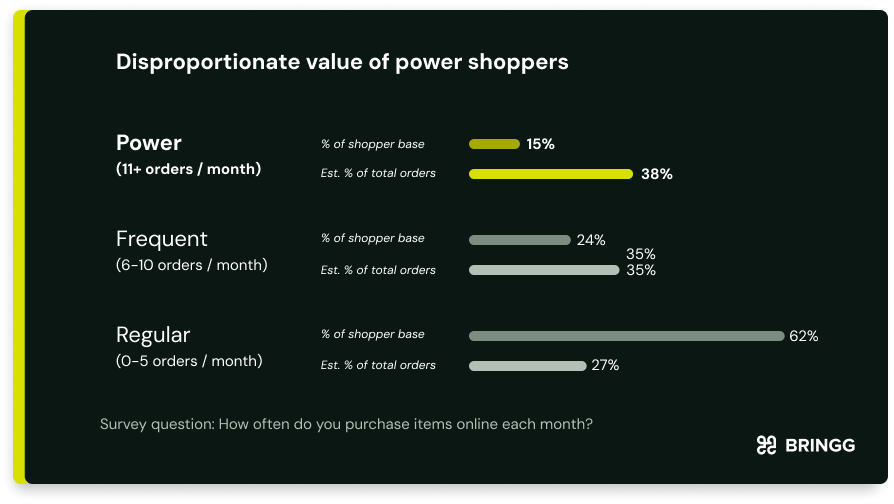
The Bringg 2026 Delivery Experience Study calls consumers who place 11 or more online orders per month “power shoppers”. The data shows that they are only 15% of online customers but order 10 times more than “regular shoppers” (zero to five times a month).
That concentration of volume makes power shopper loyalty disproportionately valuable. It also makes their churn disproportionately expensive.
Losing a regular shopper costs a retailer a handful of orders. Losing a high-value shopper costs dozens of transactions per year, along with the compounding revenue that each one generates. And replacing that shopper is far more expensive than retaining them: every lost high-frequency buyer forces a retailer back into the acquisition cycle for a customer segment that took time and consistent execution to earn in the first place.
And these shoppers don't churn quietly. They evaluate delivery before they ever visit a retailer's website, hold retailers to a higher standard once they do, and walk away faster when that standard isn't met.
Learn how power shoppers evaluate delivery differently than other segments, why they churn faster after delivery failures, and what retailers can do to retain them through more reliable, flexible delivery experiences.
Read the full 2026 Delivery Experience Study to get even more insights.
Delivery is a pre-purchase filter, not a post-purchase detail
For most consumers, delivery enters the picture at checkout. High-value shoppers consider it much earlier.
According to the study, 53% of power shoppers think about delivery options before they start shopping compared to 36% of regular shoppers. Another 26% evaluate delivery while browsing. Combined, 79% factor delivery into their experience before they reach the cart.
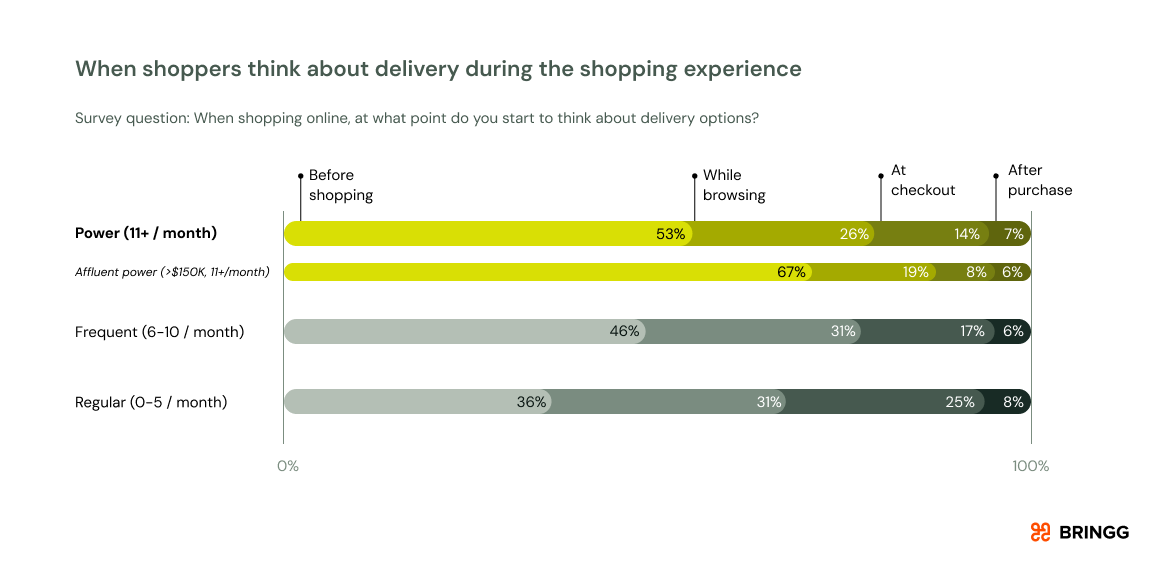
Among affluent power shoppers (those who earn more than $150,000 annually and order 11 or more times per month), the number is higher: 67% think about delivery before shopping and 86% consider it before checkout.
This means delivery reputation functions as a filter. High-value shoppers narrow their options to retailers they trust to deliver reliably before they browse a single product. Retailers with unclear delivery promises, rigid windows, or a history of missed ETAs lose these shoppers before the first click.
High-value shoppers churn quickly after a bad delivery
Delivery failures affect every shopper segment. But high-value shoppers react more strongly, act more quickly, and retain the memory longer, especially for bad deliveries.
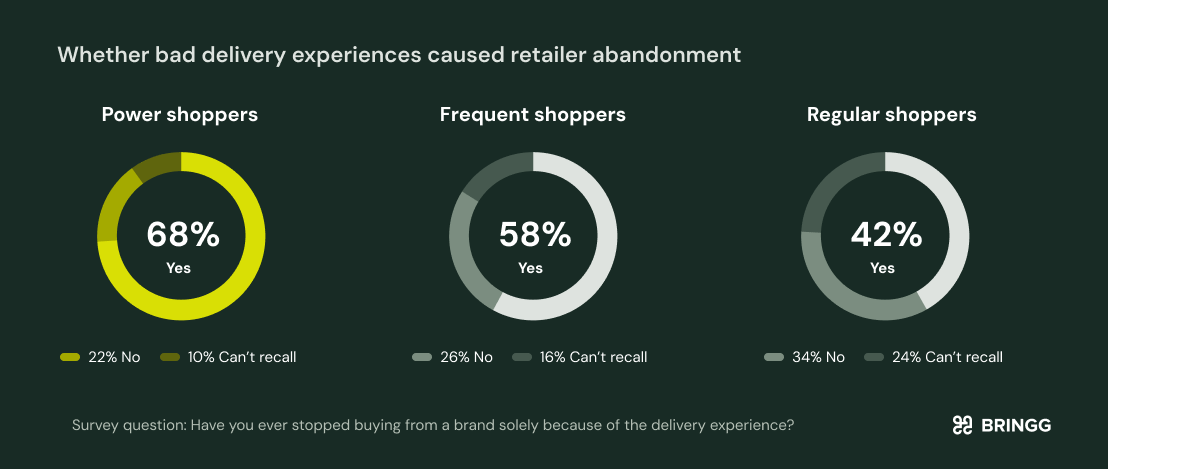
Sixty-eight percent of power shoppers say they stopped buying from a brand solely because of delivery. That figure reaches 79% for affluent power shoppers but only 42% of regular shoppers say the same.
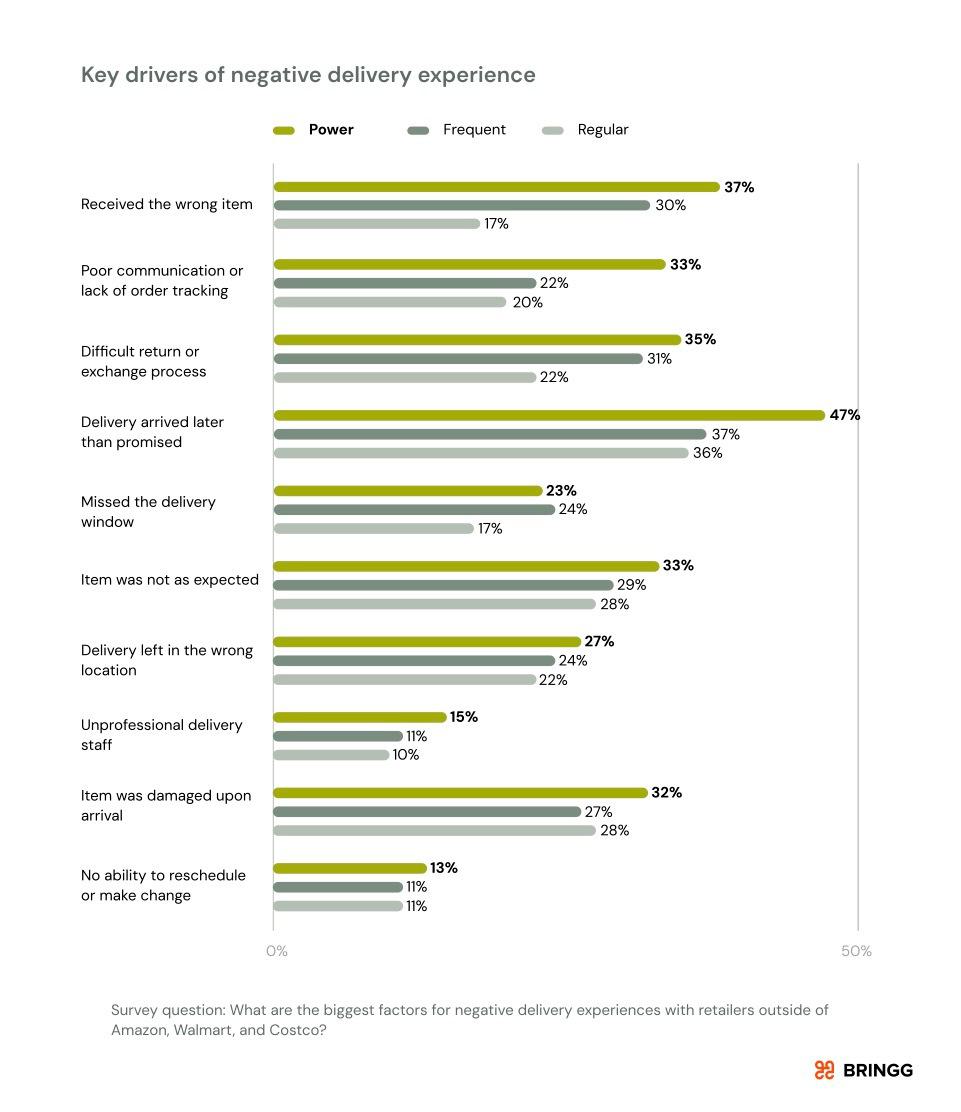
Late delivery is the single biggest factor behind negative experiences across all segments, but the intensity varies. Forty-seven percent of power shoppers cite it as their top concern, compared to 36% of regular shoppers. Beyond lateness, power shoppers also scrutinize poor communication, difficult return processes, and missed delivery windows at higher rates than other cohorts.
The recall gap reinforces the pattern. When asked whether a negative delivery experience influenced future buying decisions, 24% of regular shoppers couldn't remember while only 10% of power shoppers said the same. High-value shoppers don't forget bad delivery. They catalog it and adjust their behavior accordingly.
Power shoppers also escalate. Seventy-eight percent contact customer support after a failed delivery, compared to 72% of regular shoppers. And if the issue goes unresolved, 52% stop shopping with the retailer entirely, versus 41% of regular shoppers. For affluent power shoppers, that number jumps to 64%.
The pattern compounds since high-value shoppers experience more deliveries per month, which means more chances for something to go wrong. Nearly one in four deliveries miss the mark for frequent and power shoppers, which translates to two to three negative experiences every month. At that volume, even minor issues erode trust quickly.
What high-value shoppers demand from delivery
Attracting and retaining high-value shoppers doesn't require a fundamentally different operation. It requires a sharper one.
The study identifies reliability and flexibility as the two pillars that separate table stakes from true differentiators for this segment.
Reliability goes beyond on-time arrival. For power shoppers, it includes live tracking with proactive delay notifications, exact delivery windows, responsive customer service, and white-glove options like installation and setup for big-ticket items. Half of power shoppers value white-glove services compared to just 28% of regular shoppers, making it one of the largest expectation gaps between segments.
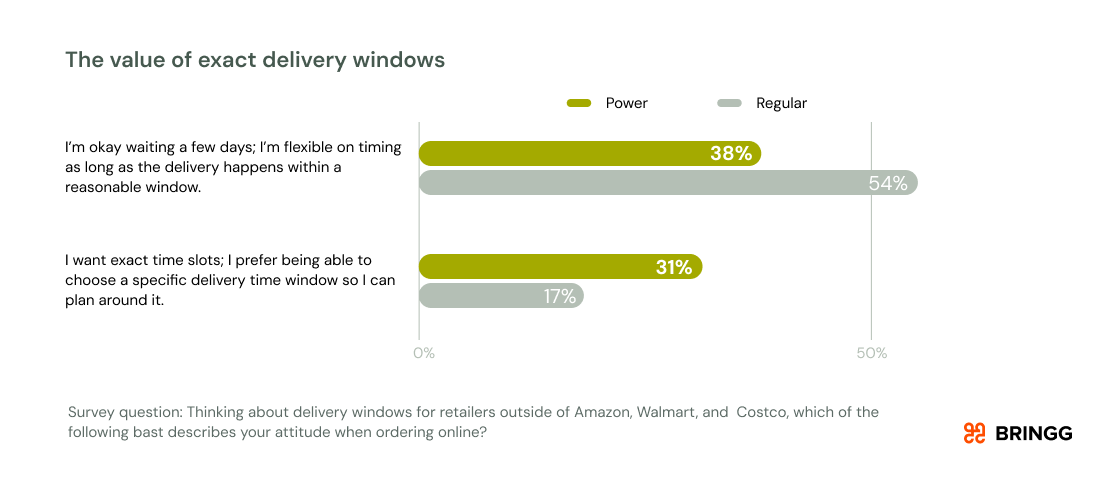
Flexibility gives consumers control over the experience. Power shoppers place a premium on delivery window selection, easy rescheduling, and same- or next-day options. But speed alone isn't the driver. The study shows that when combined with flexible scheduling, same-day delivery functions as a control mechanism. Essentially, high-value shoppers want to decide when delivery happens, not just that it happens fast.
Free shipping and easy returns remain baseline expectations across every cohort. The difference is that high-value shoppers treat those as the starting line, not the finish. Retailers that invest in reliability and flexibility protect the loyalty of their most valuable segment without alienating regular and frequent shoppers in the process.
Regular and power shoppers contribute to business performance in different ways but not all contributions carry equal weight. Power shoppers, though less than one-fifth of the consumer base, have an outsized influence on order volume. Delivery functions as a loyalty driver, a price equalizer (81% reorder after a great experience even at a higher price), and a trigger for permanent churn with this cohort.
Retailers that segment their delivery strategy around a few key reliability and flexibility elements protect the revenue these shoppers generate. Those that treat delivery as a uniform, cost-only equation risk losing their most valuable consumers silently and early.
Read the full study for deeper insights and the full methodology


