
AI is one of the most debated topics in last-mile logistics. The organizations getting results share a pattern: they define the problem before they buy the tool, get their data in order before they scale, and experiment in ways that don't put live operations at risk.
The ones that don't get results share a different pattern: tools that don't deliver, teams that don't adopt, and investment that adds complexity instead of removing it.
In this compilation episode of Deliver: The Last-Mile Performance Podcast, hosts Bringg CEO Guy Bloch and Sales Engineering Lead Raquel Zanoni draw on conversations from across the season to examine where last-mile AI is actually moving the needle. The episode features clips from:
- Cambridge Capital Managing Partner Benjamin Gordon
- McKinsey Expert Associate Partner Ali Kamil
- Canadian Tire Board Member Chris Rupp
- SEKO Logistics Senior VP of Product Management Jamie Andrade
Watch the full episode to the unique insights each expert provides.
Key takeaways
Workflow automation, pricing intelligence, and cost reduction are where last-mile AI has the highest ceiling today
- AI delivers the most measurable value in last-mile operations when applied to discrete, well-defined process problems: automated workflow steps, real-time pricing decisions, and leaner teams that scale without added headcount.
- C.H. Robinson focused two AI agents on two specific problems, response rate and response time, and produced a 56% stock price increase in a year when the broader freight market contracted.
- Organizations that start with a specific operational problem and work backward to the technology consistently outperform those that start with the technology and search for a problem to attach it to.
AI's near-term impact in last-mile operations falls on the operator side, not the customer side
- The delivery experience a customer sees has not changed dramatically with AI adoption. The change sits inside the operation, at the driver and dispatcher level, where AI handles routing decisions, proactive schedule adjustments, and automated notifications.
- Labor is the biggest cost line in last-mile operations. Automated dispatch and notification capabilities compress that cost without a reduction in service levels.
- Organizations that frame AI adoption as a customer-facing initiative before the operational foundation exists solve the wrong problem first.
Organizations that skip team alignment and data standardization before deploying AI consistently underperform
- AI cannot fix what broken systems and misaligned teams already got wrong. Non-standardized processes cannot be automated, and unclean data cannot produce reliable outputs.
- A tool deployed before those conditions exist adds complexity rather than removes it. Organizational buy-in is a prerequisite, not an afterthought.
- The ideal sequence: buy-in first, then data structure, then process standardization, then the tool.
Most organizations go wrong by letting vendors define the problem for them
- Pressure to act on AI frequently outpaces the internal diagnostic work required to act on it well. Teams attend conferences, see vendor demos, and subscribe to tools built around someone else's use case rather than their own operational bottlenecks.
- A vendor's tool may solve one or two problems. An internally defined problem statement surfaces all of them, and the build-vs-buy decision follows from that clarity.
- Organizations that start by mapping their own bottlenecks also build the data foundation that makes every subsequent AI investment more effective.
Meeting users where they are is the most reliable path to AI adoption in last-mile operations
- AI tools that require operators to change their core workflow face resistance. Tools that integrate into systems operators already use get adopted. The difference between a successful implementation and an unused subscription often comes down to where the AI lives, not what it does.
- Building within an existing ecosystem also resolves data security and privacy concerns that surface when third-party tools process sensitive shipment and customer data.
- A contained start builds the standardized data foundation that more advanced AI applications require later.
Experimentation in the last mile does not have to put live operations at risk
- Logistics is mission critical, but a complete avoidance of experimentation carries its own risk. Organizations that do not build AI literacy and operational confidence now face a larger gap later.
- The right path is analytical first: use AI to surface patterns in existing data, model routing scenarios, and run hypothetical supply chain configurations before any production change.
- Test one variable in one market before any broader rollout. Organizational confidence in AI-driven decisions has to precede scale.
Where can AI be most useful in last-mile delivery?
Benjamin Gordon, managing partner at Cambridge Capital, said AI produces the highest ceiling where the problem is specific, the data is clean, and the organization has committed to solving something defined rather than deploying something fashionable.
He frames it around three areas where that condition is most reliably met in last-mile logistics today: workflow automation, pricing intelligence, and cost reduction. Workflow automation captures the most attention for a reason. Logistics is a series of connected process steps, and AI is well-suited to take those steps and remove the manual handoffs between them.
Gordon gave an example from C.H. Robinson that anchors the argument. Robinson launched 30 AI agents and focused two of them on a specific, measurable problem: the company was responding to only 60% of inbound requests for quotes, with an average response time of 20 minutes. Neither number was acceptable in a freight market where decisions happen in real time. The agents drove the response rate to 100% and cut response time to under 30 seconds.
"In a year where the freight industry was getting crushed, C.H. Robinson had revenue up, gross margin up, bottom line up, metrics across the board up, and stock price reflected all that—a 56% increase," Gordon said. "To me, that's one of the best examples to show that AI isn't just about something that techies talk about. It's something that smart CEOs are using to create real value and real impact in transportation and logistics."
Watch “AI in Last-Mile Delivery: What Works and What Doesn’t — with Benjamin Gordon”
How is AI changing the role of operators in last-mile delivery?
The customer experience of delivery has not changed dramatically with AI adoption. Visibility, notifications, and scheduling flexibility were already table stakes before AI entered the conversation. What has changed is what happens inside the operation at the driver of and the dispatcher level.
Ali Kamil, expert associate partner at McKinsey, draws a clear line between the customer-facing experience and the operator-facing one. The AI that matters most right now is not the AI a customer interacts with. It is the copilot running alongside the people executing the delivery.
"If I'm a retailer with a delivery function, I have a copilot for drivers who are telling me where I should go next,” Kamil said. “It's helping me decide where do I need to park. When do I need to inform the customer that I'm on the way? If I'm running a little late, be proactively adjusting my schedule. These are areas that I'm seeing technology really driving impact for the operators."
The downstream consequence is the one that matters to a CFO. The biggest cost line in last-mile operations is labor. Automated dispatch and notification capabilities compress that cost gradually, without requiring a reduction in service levels.
"The cost of operations is going to quickly shrink because you're bringing this automation in this space while keeping the level of the service and experience that customers have come to expect," Kamil said.
Watch “Why the Last Mile Will Be Crucial Over the Next Decade — with Ali Kamil”
What does an organization need to do before deploying AI tools?
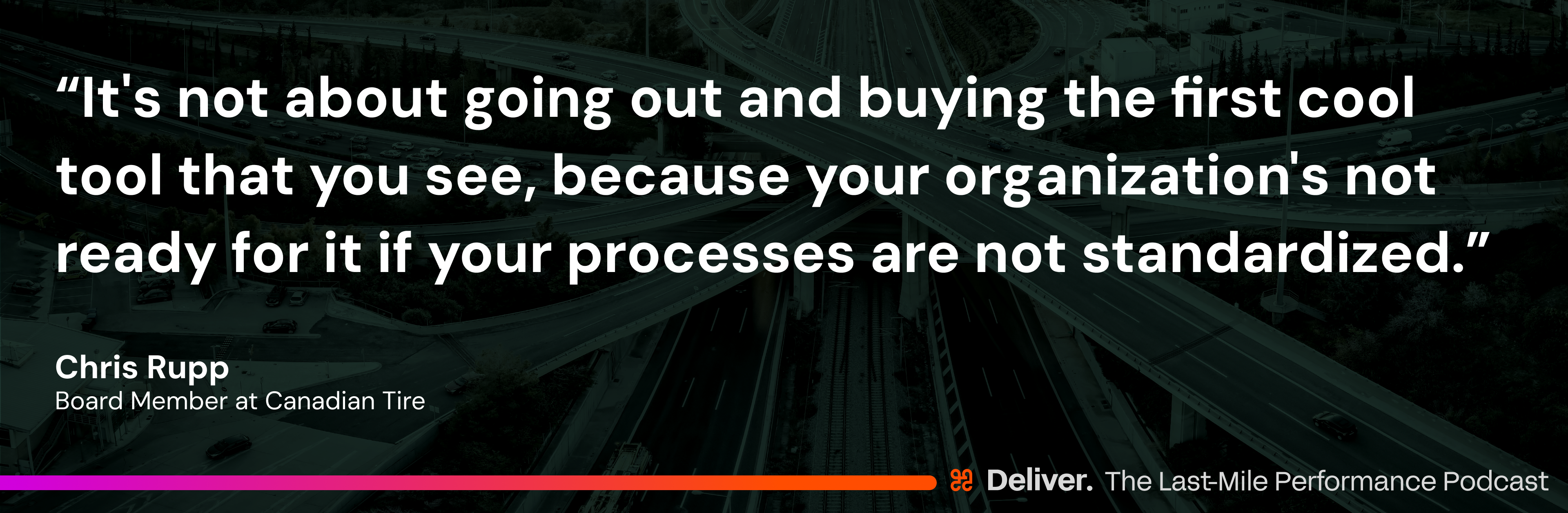
Deploying an AI tool before the organization is ready for it does not accelerate performance. In fact, it adds a layer of complexity to problems that were already there, according to Chris Rupp, board member at Canadian Tire and the executive who launched the first Amazon Prime Day. The tool reflects the quality of the inputs it receives, and if those inputs come from non-standardized processes and unclean data, the output is noise.
"It's not about going out and buying the first cool tool that you see, because your organization's not ready for it if your processes are not standardized and your data is not clean and ready to go," Rupp said. "If those two things are not in place, then AI cannot fix what systems have already broken. It's the same old garbage in, garbage out that software has been for decades."
The sequence she describes moves through three stages. First, win hearts and minds. Every person in the organization has heard that AI is coming for their job, and that fear will produce active resistance if it’s not addressed before implementation begins. Second, get the data structure right and clean. Third, standardize the processes, because automation requires a standard to operate against.
"You can't automate what is not standard in the first place," Rupp said. "And so once those things are in place, now you're ready to roll."
Watch “Don’t Give Customers Away. Keep the Delivery Promise — with Chris Rupp”
How should retailers and logistics providers evaluate AI tools?
The pressure to act on AI in logistics organizations frequently outpaces the internal diagnostic work required to act on it well. Senior leadership signals urgency. Teams attend conferences and see a wall of tools. Vendors offer demos built use cases they define. The result is tool subscriptions that don't deliver value because the problem the tool solves differs from what the organization actually needs.
Jamie Andrade, senior vice president of product management at SEKO Logistics, said this pattern is one of the most common mistakes she sees in the industry.
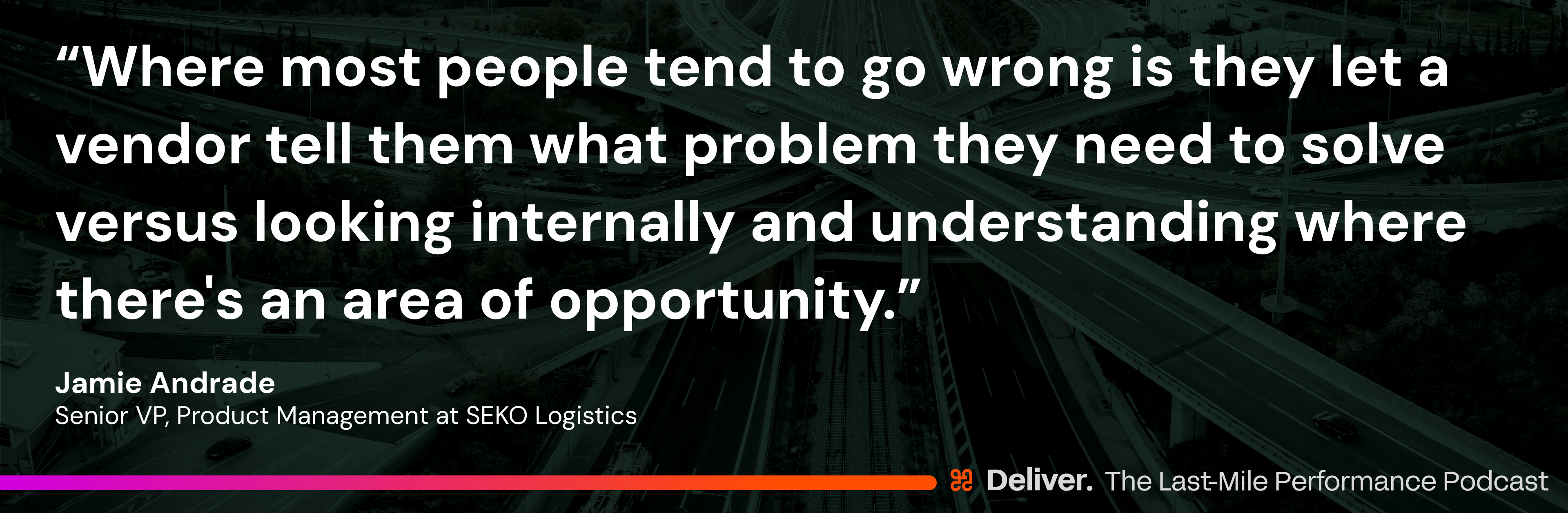
"Where most people tend to go wrong is they let a vendor tell them what problem they need to solve versus looking internally and understanding where there's an area of opportunity," Andrade said. "That's a really dangerous road to go down because that vendor may only be able to solve one or two of those problems versus if you actually take a step back and understand where there's bottlenecks in your process."
There’s also a data readiness problem that compounds the solution mismatch. Most organizations overestimate how clean and connected their data actually is. Between an operating system and a CRM, getting those two systems to talk reliably is already a significant challenge. Layering an AI tool on top of that fragmentation only makes it worse
"Nobody's got their data so clean in a little box with a bow that a lot of the tools out there are even going to give them the scale and the output," Andrade said. "And I think that's where the industry's gone a little backwards—there's all this pressure from the senior level to do something with AI and do something with automation. And so people subscribe to these tools and not getting the value. Well, because you didn't start with what is the problem."
Watch “Most LSP Data and Integrations Are Broken. Here’s How to Fix Them — with Jamie Andrade”
What does effective AI implementation look like in a last-mile operation?
The most effective AI implementations in last-mile operations share a trait: they integrate into the workflows operators already use rather than asking operators to build new ones. Adoption follows fit. Tools that live inside the systems people already work in get used. Tools that require a behavior change get abandoned.
In another clip from Andrade's episode, she said her team at SEKO approached implementation by starting with that constraint. The biggest cost in a logistics operation is labor. The goal was to grow and scale without incrementally adding headcount. But the starting point was not AI, it was a systematic audit of where manual tasks were consuming time that could be recovered.
"Not everything has to be sexy and AI in order for you to take some efficiency or take some manual work out of the business," Andrade said. "So we started there with, where are there areas of opportunity, and then where can we add something that's a little more impactful?"
The tool SEKO built lives inside Outlook, which resolves both the adoption problem and the data security problem simultaneously. Processing shipment and customer data through a third-party AI tool raises questions about how that data is stored and whether customers have consented to its use. Building within a known, controlled ecosystem removes those questions from the evaluation entirely.
Andrade also gave an example of a proof of delivery automation that proved impactful. Previously, processing a proof of delivery required an operator to copy a shipment number, navigate through seven tabs in an operating system, manually enter delivery date, time, and recipient name, and attach the document. An AI layer now scans the email, identifies the job number, pulls up the record, and presents a confirmation sidebar. One click completes what previously took several minutes of manual entry across multiple systems.
The organizations that close the AI adoption gap in last-mile operations tend to solve for the worker before they solve for the technology.
Watch “Most LSP Data and Integrations Are Broken. Here’s How to Fix Them — with Jamie Andrade”
How can retailers and logistics providers experiment with AI without disrupting operations?
There’s real risk in AI experimentation given that an incorrect decision in a mission-critical environment can produce a failed delivery, a damaged customer relationship, and a cost that ripples through the operation. However, Gordon argues that leaders can bypass that risk by experimenting with AI in an analytical layer before pushing it into live operations.
He said the lowest-risk entry point for AI experimentation in last-mile operations is throwing it at data that already exists. Rather than touching live operations, organizations can use AI to analyze current performance, surface patterns, and model alternative decisions (like different routing configurations, different DC placements, different pickup frequencies).
Learn from those scenarios before changing anything in production. Then test one variable in one location and measure the result before rolling anything out.
Watch “AI in Last-Mile Delivery: What Works and What Doesn’t — with Benjamin Gordon”


