What Separates Last-Mile Leaders When Everyone Has AI?
Alton Zenon III
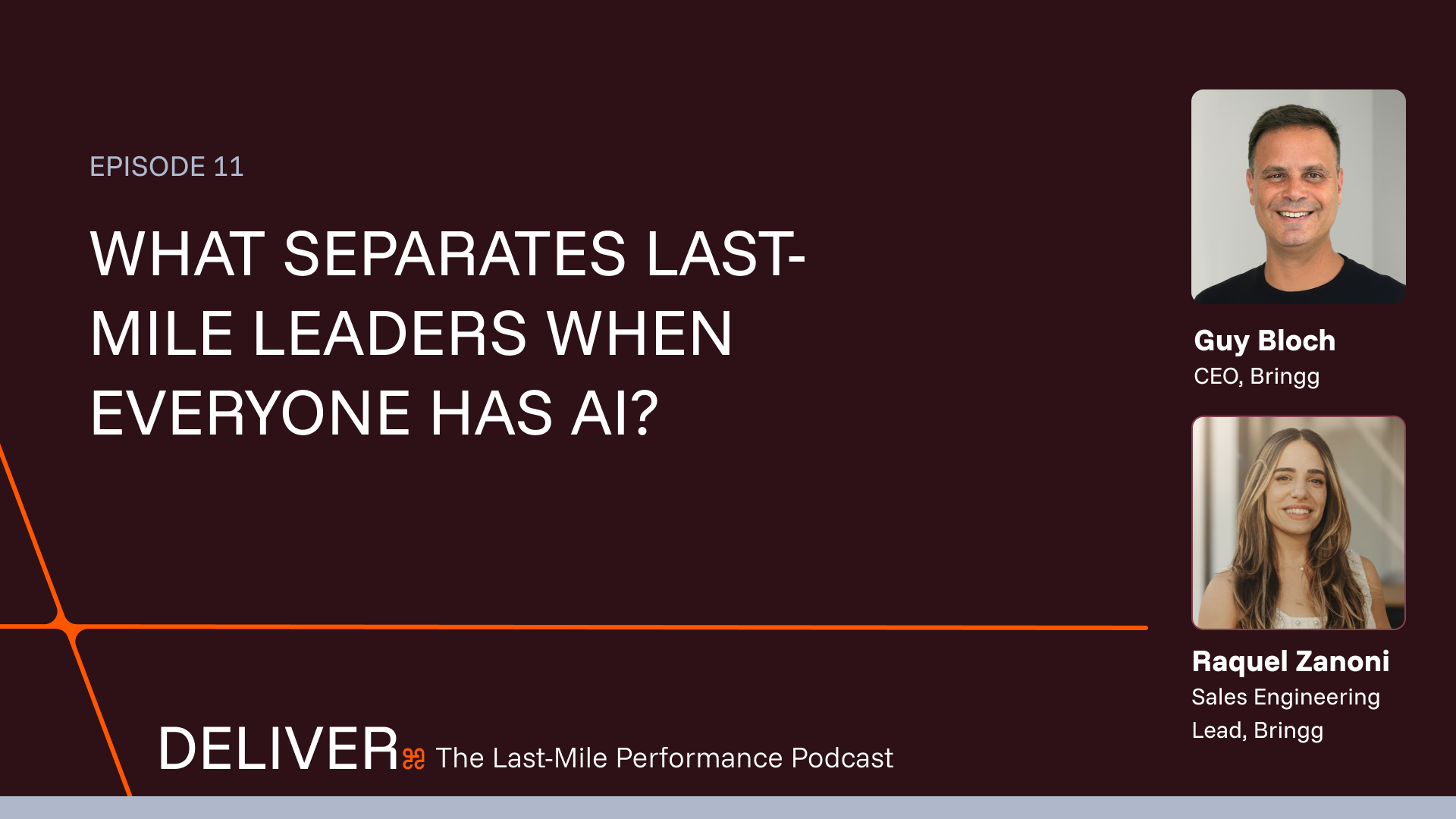
AI has made it possible for almost any retailer to stand up a decent version of the same last-mile technology. That levels the field on software and leaves open the harder question of what sets one operation apart from another. The answer comes down to judgment, order density, and knowing which parts of the operation to buy instead of build.
On this episode Deliver: The Last-Mile Performance Podcast, Bringg CEO Guy Bloch fields questions about these topics and the current state of the last mile from co-host Raquel Zanoni, Bringg’s sales engineering lead.
The two cohosts chat about where human judgment fits into a last-mile landscape that’s heavily influenced by technology, how smaller retailers can close the cost gap with the largest players, and when to build or buy fleets and technology.
Play on
What happens when AI makes last-mile technology table stakes?
Guy treats the arrival of table-stakes technology as good news.
“For years, companies competed on who built the better routing engine or the better dispatch screen. AI collapsed that gap. Everyone can get to a decent version now,” he said.
What separates them today is how well the people running the operation use it: the operations leader who knows a given region cannot absorb a late-afternoon wave in peak season, the dispatcher who sees the pattern before the dashboard does, and the team that understands why the numbers look the way they do.
“AI can recommend,” Guy said. “What it cannot yet tell you is which recommendation will break your Saturday. That’s the big difference, because that’s the judgment, that’s the instinct, and this is what separates one operation from another.”
Which last-mile decisions should stay with people over technology?
Guy said that human judgement belongs wherever a wrong call is costly or personal and pointed to three areas where that discernment is necessary:
- Liability and legal exposure
- Financials, wherever money moves
- Customer understanding: who customers are, what is unique about them, and how their experience gets personalized
People in those areas can read the metrics, see through them, and direct agents to do work that used to be manual. Their job, as Guy put it, is to “call the right shots and always defend the house.”
Raquel added a view from customer care, where AI investment is heavy on responding to where’s-my-order calls. She gave an example of a delivery gone wrong she experienced and said that a robot’s answer is fine until things escalate, and then customers want a person. The experience can stay human while AI and automation go after the parts of the last mile that drive cost up.
Guy agreed and offered a practical test: analyze what each role does every day, identify the tasks that can be automated, and hand those to AI.
“The agent will not create reality for you,” Guy said. “You have to have that vision and bring it to life. The agent will help you do that. You have to control it.”
How can AI improve last-mile decisions once the core technology is in place?
“You have your infrastructure in place, technology is in place, automation is in place, optimization in place, everything is in place,” Guy said. “What is next?”
The next gain comes from decisions that people struggle to make on their own, which he calls decisioning. It applies once a retailer already has its infrastructure, technology, automation, and optimization in place, the stage where more of the same yields little.
He used an example of a retailer building a capacity plan for the next week. Hundreds of business analysts could build that plan, and even their best recommendation “will never have the power that agents have,” Guy said.
“That’s the whole idea of collecting your data, normalizing your data, and preparing your data so the agents can come and help you make those decisions,” he continued. “And in some cases, even leave them the ability to make decisions that humans struggle to make on their own.”
But people still direct the agents. He described AI as moving retailers in two directions—decisioning and sourcing more scale.
How do smaller retailers compete on delivery cost with the largest players?
Delivery cost follows order density, and a few giants hold enough of the online market to potentially run hundreds of orders per wave in a single zone. The more scale a retailer sources, Guy said, the further its cost per delivery falls. The question for everyone else is how to get closer to that density. He sees three routes:
- Join the giants’ networks.
- Build a private network, standing up fleets where it makes sense, and accept that it will always be a fraction of the giant network.
- Bring demand together with the rest of the market to create hundreds of deliveries in one zone, in one wave, and drive prices very close to what the industry golaiths have today.
“If you can take the rest of the market’s demand and start pulling it together, at that point, you become an alternative to any other giant,” Guy said. “Why? Because now you share all the demand together, you’re pulling it together, you’re creating hundreds of deliveries in one zone, in one wave, and now you’re in a position to drive your prices very close to what the giants have today.”
The third route is challenging but it’s a problem that is solvable rather than a dependency retailers must live with.
“When you bring the demand and the supply of the rest of the market, the part that is not part of the giants, now you start acting like a giant without the assets of that giant.” Guy said.
What pushes retailers to rethink their delivery networks?
Pain. Guy said retailers only take the step toward consolidating demand with the rest of the market—something not tried before in the market—when the current approach hurts enough. “Life is beautiful,” while technology, automation, and optimization close the gaps and are good enough. But once retailers reach the ceiling and see that there is not much else to gain, the only way through the glass ceiling is scale.
Guy said he’s having conversations in the market that already point that way. Complaints have shifted from automation and optimization, where retailers feel they have a good handle and can find another couple of points of improvement, to unit economics. Capacity comes first.
Serving demand takes flexible fleets rather than one. This brings along contract management, settlements, payments, and RFPs that are not the core business. Rate comes second. A retailer whose rate starts higher than a giant competitor’s can push the gap to customers who can buy the same product cheaper elsewhere, or absorb it and stop being a sustainable business.
“What kills them today is, first of all, capacity,” Guy said. “To serve their demand, the capacity is still not there.”
Raquel asked whether a mindset shift has to happen first.
“It will happen,” he said. “It’s a question of time. Solutions come when the problems call out for them.”
When should a retailer own its delivery fleet?
Raquel framed this around a scene most operators will recognize: companies that made a fleet bet years ago and feel boxed into it now. She asked how to weigh committing to owned delivery assets against staying flexible with outside capacity.
“You don’t own a fleet just because you want to own a fleet,” Guy said. “You own a fleet because the numbers tell you that that’s the right thing to do for the business.”
If a zone reaches a density where a retailer’s own drivers bring cost per delivery down and service quality up, build and commit. When the numbers aren’t there yet, don’t build ahead of them. Use third parties and keep pulling in demand until the zone justifies it.
“Where the numbers are not there yet, don’t build ahead of them, because the expensive part of a fleet decision is not making it or building it,” Guy said. “It’s reversing it. Once you’ve signed the lease, you hired the drivers, you bought the vehicles, you’re defending that decision for years. And you actually defend it after the market moves. The market will move and you continue defending it just because you made that investment.”
“So flexibility is not avoiding the commitment. In my mind, it’s committing in the right order. And that’s what gives you the flexibility that you don’t need to commit to everything upfront.
Guy framed the whole thing as economics. The last mile behaves like an economy, with demand, supply, density, price sensitivity, equilibrium, and economy of scale. A retailer that follows the numbers can’t get it wrong.
Should retailers build or buy last-mile technology?
Raquel put the obvious objection on the table: if AI lets a team build its own version of the technology in-house, why would it ever choose not to? Guy’s answer starts with a rule he has applied across years of working with enterprises.
“I always stuck to the rule of 70-30,” Guy said. “Seventy percent of what you do runs on the infrastructure that is available in the market.”
“When it’s unique to your business, that’s the 30% that you build,” he said. “But you build it on top of existing infrastructure and not necessarily just start everything from scratch.”
Guy said building the visible steps is the easy part: An order comes in, it goes to a driver, and the driver delivers it and keeps the customer informed. Simple. He said the hard part is keeping the delivery promise a retailer makes to its customers. Before a retailer makes a promise, the entire operation has to be ready for it:
- Inventory in place
- The driver at the right store
- Associates ready for the pickup
- Customers informed along the way
Vendors spend years learning where that chain breaks and that benefits operators who need that knowledge.
“You’ll never be in the 10,000 hours that those vendors are out there building, innovating, addressing edge cases,” Guy said.
Raquel pointed to the cost of going it alone. Building everything in-house can create an echo chamber, she said, and from what she has seen, subject matter expertise during the process makes a difference.
Guy agreed that no one knows what they don’t know. His view is that technology is just table stakes, and the expertise on top of it is what makes a retailer successful. If the technology itself generates revenue as part of the business, build it. If it isn’t, lean on vendors that have built it hundreds of times and made it work.
What should retailers do differently on Monday morning?
Raquel closed with the question the show asks all of its guests: given everything covered in the conversation, what is one thing retailers should do differently on Monday morning?
Guy called Monday morning tactical rather than strategic, and his answer was a meeting. The agenda is the last peak, replayed line by line: every promotion, every threshold change, every delivery promise, and what each one did to capacity and cost per order.
“Put the person who owns delivery and the person who owns pricing in the same room and walk through the last peak together,” Guy said. “Most companies have never had that conversation, let alone talk about all the other aspects that we discussed today. And the moment they do, they stop treating last mile as an operational layer. At that point, they start managing it like it was an economy.”
Guy added that this is how the last mile has moved from the basement into the boardroom over roughly the past couple of years. Every point of improvement in last-mile KPIs goes straight to EBITDA, he said, and in some cases is measured in millions of dollars. Raquel’s sign-off to retailers was to have that meeting.
What is last-mile decisioning?
Decisioning is using clean, normalized operational data so software agents can make calls, such as a weekly capacity plan, that people struggle to make unaided. Bringg CEO Guy Bloch describes it as the next gain after routing, dispatch, and optimization are in place.
What is the rule for building versus buying last-mile technology?
There’s no industry benchmark for building versus buying last-mile tech, but Guy Bloch has a 70-30 rule of thumb: Run about 70% of the operation on infrastructure available in the market and build the 30% that is unique to the business on top of it.
When does owning a delivery fleet make sense?
When order density in a zone lowers cost per delivery and raises service quality. Guy recommends proving the model in a few zones, operationalizing it, and replicating it, while using third-party carriers elsewhere.
How do pricing decisions affect last-mile capacity?
Guy’s point is that each promotion, threshold change, and delivery promise affects capacity and cost per order, and most companies have never traced those effects. He recommends that delivery and pricing owners review the last peak together.