
eCommerce sales growth is expected to increase 7% annually and reach a total of $7.89 trillion in 2028, making eCommerce delivery one of the most frequent retailer-shopper interactions. When delivery goes well, it reinforces trust. So much so that 65% of shoppers say they would buy from that retailer again, even if the price is higher than a competitor’s.
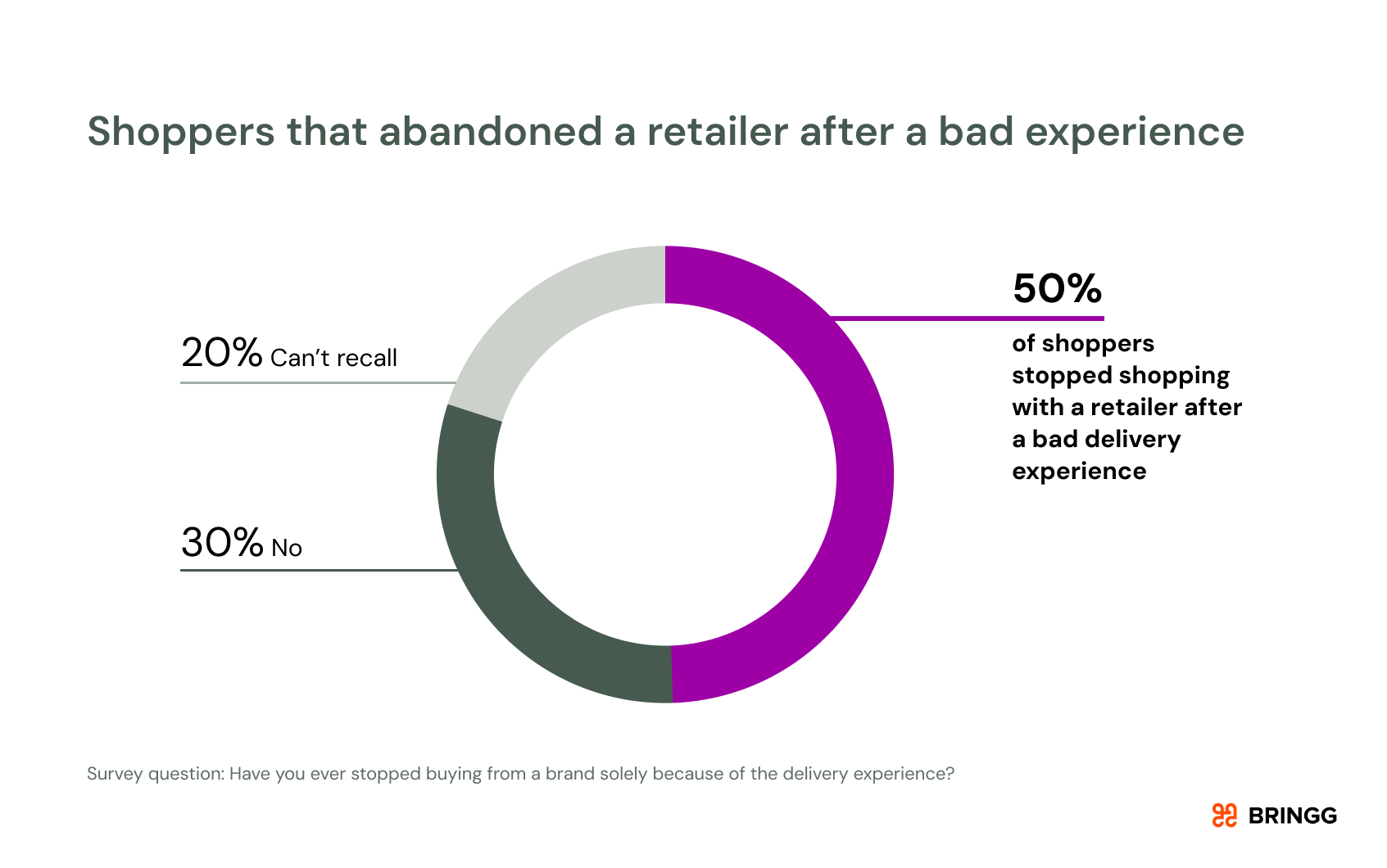
But when delivery goes wrong, the opposite is true: 50% of shoppers say they stopped buying from a brand after a negative delivery experience. That figure jumps to 68% for shoppers who make more than 11 orders a month ("power shoppers"). Bad delivery impacts loyalty, leads to attrition, and affects customer lifetime value (especially for high-value shopper groups).
Delivery failures can no longer be treated as isolated incidents or inconsequential. Now, brands win or lose customers at the front door.
Key factors of a bad delivery experience
The 2026 Delivery Experience Survey asked 1,040 consumers what factors contributed most to a poor delivery experience. Damaged items and high-costs are major risks but those are largely considered table stakes. Consumers pointed toward a broader set of delivery failures, most of them tied to broken reliability and lack of control.
Broken reliability signals
- Late delivery
- Wrong or damaged items
- Delivered in the wrong location
- Early or unexpected delivery
Visibility and communication breakdowns
- Poor or missing tracking updates
- Lack of proactive communication during delays
Lack of control
- Inability to reschedule or make changes
- Rigid delivery windows that don’t align with consumers’ schedules
How bad delivery affects high-value shoppers
Not all shoppers respond to delivery failures the same way. Power shoppers, who place 11 or more orders per month, represent 15% of the consumer base but account for an estimated 38% of total orders. Their loyalty is disproportionately valuable. So is their churn.
Sixty-eight percent of power shoppers have stopped buying from a brand after a delivery failure, compared to 42% of regular shoppers. That 26-point gap reflects a fundamental difference in how this segment processes poor delivery. Power shoppers place more orders, encounter more delivery interactions, and hold retailers to a stricter standard on precision and control. When that standard isn't met, they leave faster and with less warning than any other segment.
The revenue math compounds quickly. If a regular shopper, who places fewer than five orders a month, churns it represents a modest loss. A power shopper who churns takes an outsized share of order volume with them. For retailers competing outside of Amazon, Walmart, and Costco, this segment represents the highest concentration of delivery risk and the highest cost of getting it wrong.
The most common delivery failures
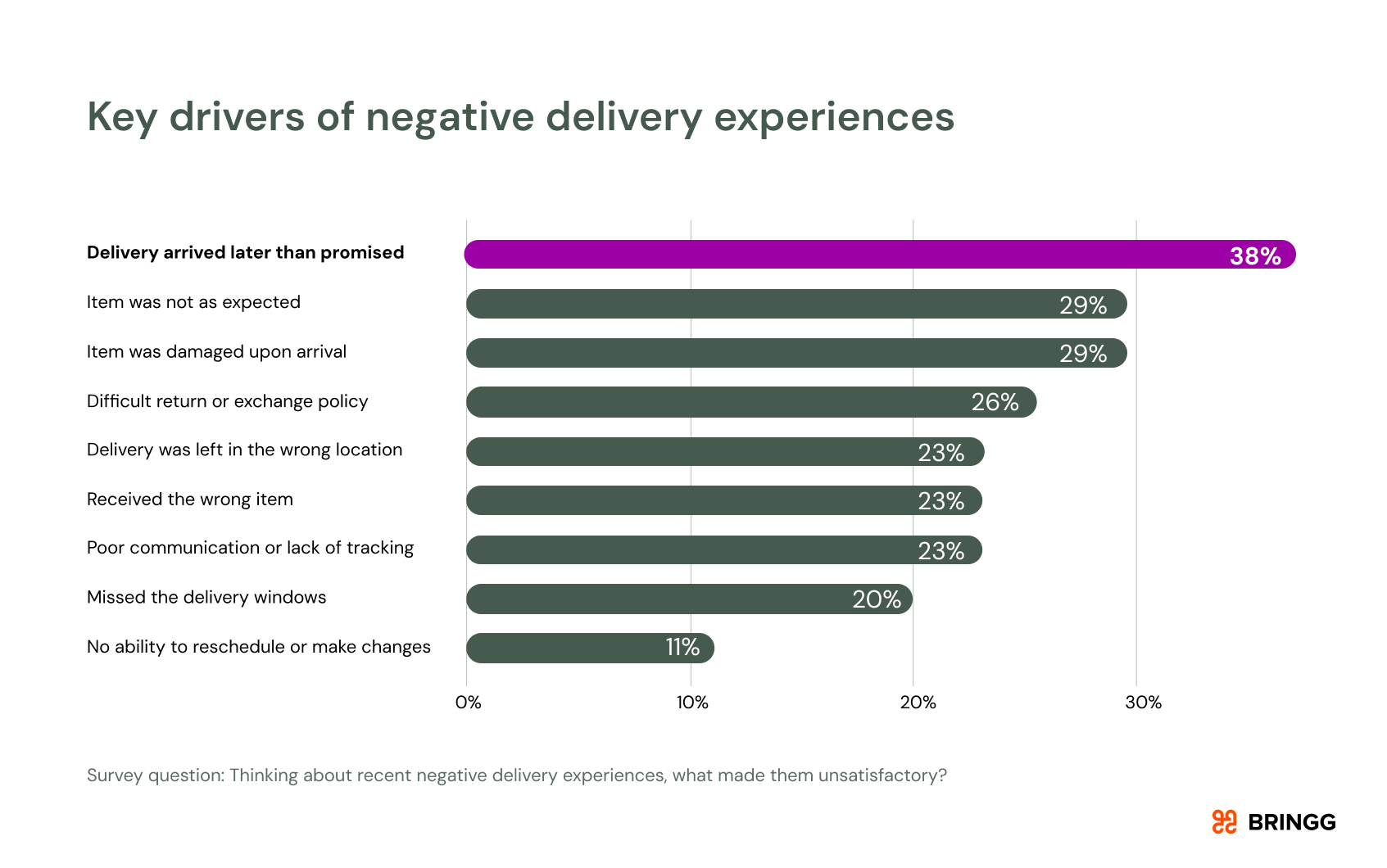
Late delivery is the single biggest driver of a negative delivery experience. Shoppers have far less tolerance for missed delivery windows than for baseline issues like damaged packages, difficult returns, or deliveries left in the wrong spot. When a delivery arrives late, it signals a broken promise that directly undermines brand confidence.
That impact compounds when there’s no order visibility: 23% of shoppers cite a lack of tracking or communication as a negative factor, demonstrating that it’s not just lateness that frustrates customers, but being left in the dark when plans change.
Power shoppers are more sensitive to accuracy and visibility failures. Thirty-seven percent cite receiving the wrong item as a negative experience driver, which is more than double the rate of regular shoppers. Poor communication or lack of tracking affects 33% of power shoppers vs. 20% of regular shoppers, and a difficult return or exchange process affects 35% vs. 22%. These failures are dealbreakers and prove a retailer can't be trusted to the segment that orders frequently and expects precision by default.
In every case, no matter the shopper group, these delivery failures risk brand reputation. Most shoppers (62%) hold the retailer either fully or jointly responsible when deliveries go wrong, even if it’s the carrier’s responsibility.
Late delivery is #1 cause of negative delivery experiences
The delivery factors that cause customer churn
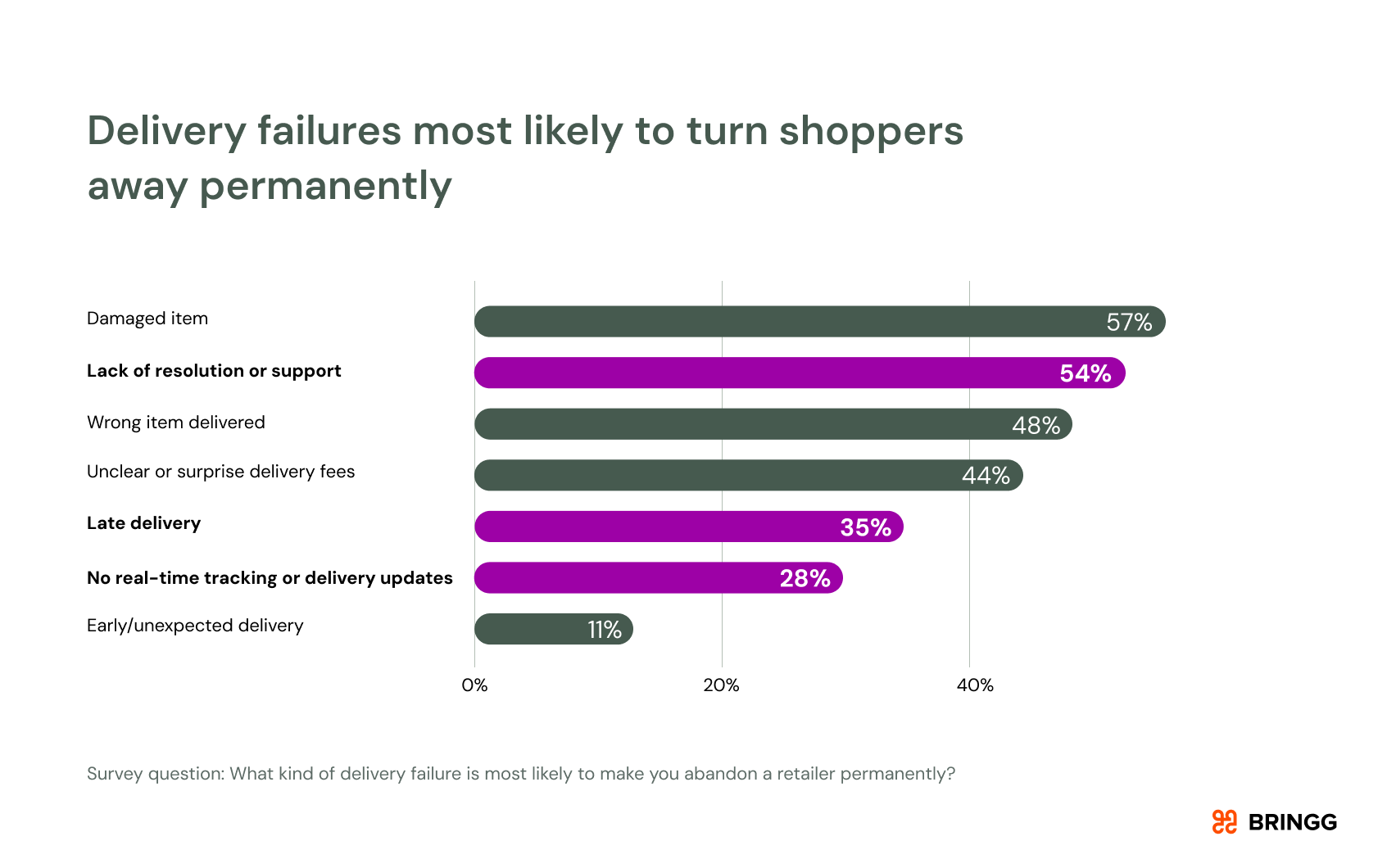
There are a number of delivery factors that push customers away for good. Receiving a damaged item is a major but obvious one at 57% churn rate. However, post-purchase assistance matters almost as much: 54% of shoppers say they would abandon a retailer if they don’t receive adequate support after a delivery issue occurs. This highlights the critical point that post-purchase support is part of the delivery experience and not a separate function. When resolution is slow, unclear, or inconsistent, even minor issues escalate into loyalty-breaking events.
Late delivery is also the number one cause of churn across all consumer segments. And 18% of powers shoppers will churn after an early delivery compared to 9% of regular shoppers [0-5 orders/month]), meaning the highest-value shoppers demand precision from retailers, or they take their business elsewhere.
Learn what makes for a great delivery experience
How bad delivery breaks trust
Bad delivery experiences disrupt loyalty in three compounding ways:
- Lower reliability means lower confidence: Late, wrong, or damaged deliveries signal that the retailer can’t consistently meet expectations.
- Inflexibility accelerates frustration: When shoppers can’t reschedule, adjust, or recover easily, friction spikes both before and after delivery.
- Poor resolution creates churn: Without fast, empathetic recovery, a single failed delivery becomes a permanent break in the relationship.
In an environment where delivery is a weekly touchpoint for most shoppers and expectations change regularly, not delivering excellence simply isn’t an option. The Bringg 2026 Delivery Experience Survey confirms that brands with the best chance of maintaining customer loyalty are those that invest in reliability, offer flexibility, and resolve problems quickly.
FAQ
Q: What makes a negative delivery experience?
A negative delivery experience stems from failures in two areas: reliability and control. Reliable delivery breaks down when orders arrive late, items are wrong or damaged, or deliveries are left in the wrong location. Visibility and control break down when shoppers can't track their order in real time, don't receive proactive communication during delays, or can't reschedule when plans change.
According to the Bringg data, late delivery is the single biggest driver of a negative experience across all shopper segments. But accuracy and visibility failures run close behind. Those gaps hit harder for high-frequency shoppers than they do for the average consumer. Thirty-seven percent of power shoppers (11 or more orders per month) cite receiving the wrong item as a negative experience driver, more than double the rate of regular shoppers (zero to five orders per month), and 33% flag poor communication or lack of tracking, vs. 20% of regular shoppers.
Q: How many bad delivery experiences does it take to lose a customer?
Not many: 16% of shoppers will stop buying from a retailer after a single bad delivery experience and another 39% will walk after two. Combined, more than half of shoppers set a threshold of two or fewer failures before they leave, regardless of product quality or price.
Nearly half (50%) of shoppers have already stopped buying from a brand solely because of delivery. The margin for error is narrow, and most retailers don't get a signal that churn has begun until it's already happened because shoppers are more likely to leave quietly than leave a negative review.
Q: Who are power shoppers and why does their churn matter to retailers?
Power shoppers are online consumers who place 11 or more orders per month. They represent 15% of the consumer base but account for an estimated 38% of total orders — roughly 10 times the order volume of regular shoppers (zero to five orders per month). That concentration of order volume makes their churn disproportionately costly.
68% of power shoppers have stopped buying from a brand after a delivery failure, compared to 42% of regular shoppers. And because shoppers are more likely to leave quietly than file a complaint or leave a review, most retailers won't detect the loss until it shows up in declining repeat purchases or lifetime value. For retailers competing outside of Amazon, Walmart, and Costco, losing a power shopper to a delivery failure is one of the most expensive outcomes that's hardest to see coming.
Q: What delivery failures are most likely to lose a customer permanently?
Damaged items and lack of resolution top the list. According to the Bringg 2026 Delivery Experience Survey, 57% of shoppers say a damaged item is most likely to make them abandon a retailer permanently, and 54% say the same about a lack of resolution or support after a delivery issue. Wrong items delivered (48%) and poor or missing real-time tracking (28%) round out the top four.
The resolution stat is worth noting separately. A damaged or wrong item is an operational failure, but a lack of resolution is a choice. Shoppers who experience a delivery failure and receive fast, empathetic support are far less likely to churn permanently than those who are left without a clear path to recovery.
Q: Do shoppers complain after bad deliveries?
After a bad delivery experience, shoppers are more likely to stop buying than to leave a negative review. Forty-two percent say they would stop shopping with the retailer altogether, while only 33% say they would leave a negative review. This imbalance creates a dangerous blind spot. Retailers that rely on reviews, complaints, or tickets as a customer satisfaction indicator often miss the true scale of the problem. Shoppers churn silently after late delivery, and the results are only visible later in declining repeat purchases or lifetime value.
Q: Who is responsible when a delivery goes wrong?
Most shoppers hold the retailer accountable regardless of who actually caused the failure. According to the Bringg data, 62% of shoppers hold the retailer either fully or jointly responsible when a delivery goes wrong, even when the carrier is at fault.
That perception gap has real consequences. Retailers that treat carrier failures as outside their control are solving the wrong problem. In the shopper's experience, there is no distinction between the brand and the delivery. The retailer made the promise and the retailer owns the outcome. Delivery operations that account for that expectation—built through proactive communication, fast resolution, and carrier performance management—separates retailers that retain trust after a failure from those that lose it permanently.
Learn what makes for a great delivery experience


