
Fast and free shipping still matters in the last mile, but reliability, control, and transparency are what truly drive customer conversion and loyalty today. Many retailers are unaware of these conversion levers and how expectations may change based on customer order frequency or whether they’re shopping for big and bulky goods.
In this Bringg webinar, 2026 Last-Mile Reality: Quality Delivery Beats Fast and Free, Bringg Director of Marketing Morgan Hass and Field CTO Ryan Leigh unpacked these differentiated customer loyalty drivers based on findings from the 2026 Bringg Delivery Experience Study. The study surveyed more than 1,000 consumers on their delivery experiences and expectations and that data fueled the conversation. Morgan and Ryan discussed how delivery expectations form earlier in the shopping journey, why power shoppers (who order more than 11 times a month) exert outsized influence on revenue, and how big and bulky delivery raises the stakes even further.
Watch the full webinar or explore the key takeaways and transcript below.
Key takeaways
Delivery influences purchase decisions earlier than most retailers expect
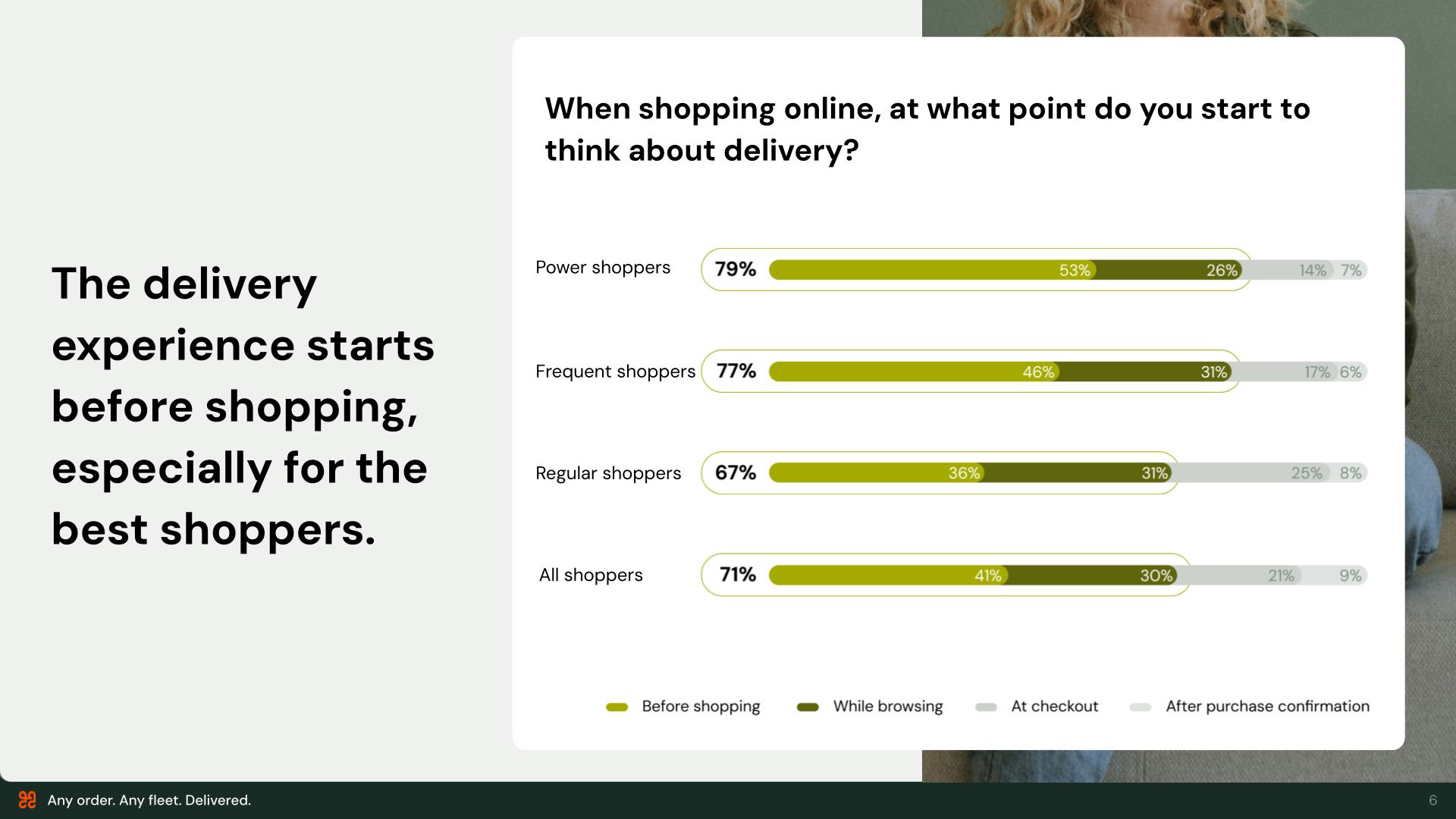
- 71% of shoppers think about delivery before checkout.
- 80% of power shoppers consider delivery before checkout.
- More than half of power shoppers think about delivery before they even start shopping, compared to 36% of regular shoppers.
This behavior means retailers lose sales before customers ever visit their site if delivery promises are unclear or uncompetitive.
Fast and free shipping no longer differentiates brands
- Speed and cost are baseline expectations dominated by marketplace leaders but shoppers prioritize reliability over speed.
- Across all cohorts, on-time arrival and responsive customer service outrank same-day or next-day delivery.
- Shoppers consistently value delivery quality more than pure speed once basic expectations are met.
The differentiator is not how fast an order arrives, but whether it arrives when promised and with clear communication throughout the process.
Power shoppers represent outsized revenue and higher expectations
- Power shoppers purchase online 11 or more times per month and represent a small share of shoppers with disproportionate impact.
- Their purchase volume can represent up to 10 times more orders than regular shoppers.
- 50% of power shoppers value white-glove services such as installation, compared to 28% of regular shoppers.
- Power shoppers consistently rate delivery factors like proactive communication, flexible scheduling, and real-time tracking higher than other segments.
Meeting power shopper expectations creates leverage for growth, not just satisfaction.
Big and bulky delivery raises expectations and risk
- Large-item deliveries are judged more harshly than parcel deliveries.
- More than half of consumers say they hold higher expectations for big and bulky deliveries than for everyday orders.
- Failures carry greater emotional and financial weight due to higher order values and delivery complexity.
Big and bulky delivery performance directly influences brand perception, repeat purchases, and tolerance for future issues.
Delivery quality drives loyalty, not just satisfaction
- Delivery outcomes influence whether customers return, not simply whether an order arrives.
- Shoppers associate delivery reliability with brand trust.
- Failed delivery promises remove retailers from future consideration, often without visibility into the lost opportunity.
Delivery is evaluated as part of the overall shopping experience—not simply a post-purchase function.
Webinar transcript
Morgan Hass: Well, hello everyone! Thank you so much for being here today. You know, for a long time, last mile delivery has been treated as a race. First, it was the race to free shipping, then 2-day delivery, next day, and same day followed on.
But today, we're seeing a fundamental shift in behavior. Fast and free shipping is still extremely important. You will not not hear that today, but they aren't key differentiators anymore for retailers. What actually drives conversion, loyalty, and repeat revenue is quality delivery, and that's what we're going to unpack today.
But first, let's start with some introductions. I'm Morgan Hass, the director of marketing here at Bringg, and the team leader of the research that we're going to be discussing today. Joining me is Ryan Leigh, our field CTO. Ryan has years of experience working with enterprise retailers and logistics organizations to improve their delivery experience, last-mile operations, and performance.
In terms of housekeeping, this webinar does have a Q&A, and we really encourage everyone to use it throughout the presentation. Please add comments and questions, and we'll talk through those at the end. All the questions will be anonymous, but we'd love to hear from you about what you're hearing in the market, and see how this data resonates in your world.
The data: 2026 Bringg Delivery Experience Study
Ryan Leigh: Thanks for the intro. We do have some key takeaways to keep in mind throughout the session, and we're going to recap these at the end as well. So I'll quickly go through those. Delivery is core to the shopping experience for the majority of consumers. That came through strongly in the research.
Ryan Leigh: While most businesses compete on fast and free delivery, it's actually reliable and controllable experiences that set them apart. Power shoppers, our small but mighty buying segment. That is something we're going to dive into in a little bit more detail, that term, power shoppers.
And big and bulky e-commerce purchases introduce even higher complexity, so for those out there that are already working for a big and bulky retailer, I'm sure that resonates. But all in all, great delivery is so important to today's shopping experiences, and it really does help to drive customer loyalty.
Morgan Hass: Thanks. So where did this data come from? This actually is from our 2026 Delivery Experience Study, where we asked real consumers how delivery impacts their buying decisions for online orders. The study was conducted anonymously late last year, features over a thousand consumers, and the initial findings were published in December. You can use this QR code to access the first report, and we'll also share it via email after the webinar. And some of the data you'll see here today is new, and will be featured in our upcoming report specifically on power shoppers.
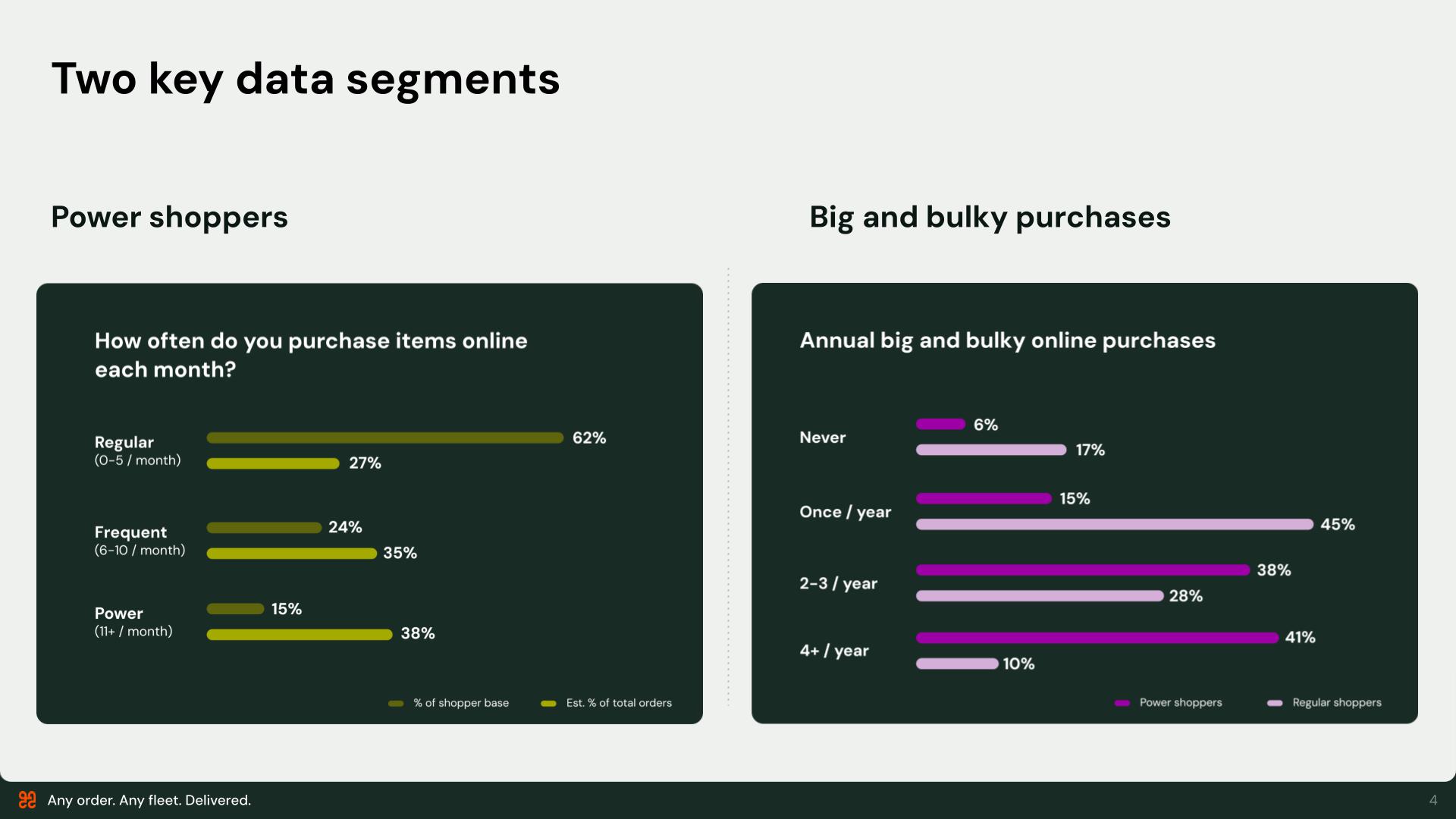
But I guess first, what are power shoppers? It is one of the two segments that stood out and that you'll hear a lot about today. Power shoppers are people that buy online 11 or more times per month, and while this sounds like a lot, it includes groceries, recurring subscriptions, and those everyday Amazon purchases that we all make.
Get more insights from the discussion in the 2026 Delivery Experience Study
Morgan Hass: They are a much smaller cohort, but they can… their purchases can represent 10 times the volume as regular shoppers, which makes their preferences and behaviors particularly interesting. The second segment that we'll focus on is big and bulky. We asked a series of questions to see how larger purchases differ from those everyday online orders.
Not only do big and bulky purchases happen less frequently, but delivery expectations are significantly higher, and shoppers are a lot more sensitive to failures when they happen.
With that said, let's get into it.
Ryan Leigh: That sounds good. As Morgan said, fast and free shipping still matter, but they're not differentiators, and we're going to see that in the data as we go through it, Amazon, Walmart, they own the market on fast and free shipping, you all know this. But e-com… as e-commerce shopping has grown, so too have delivery expectations. So, it's not just about getting it right after the fact, it's about positioning your ability to use the last mile as a differentiator, as a way to differentiate your brand, to attract customers, based on trust up front. Otherwise, you're missing out on potential revenue, and we're going to talk about how that works later.
How consumers think about delivery
Ryan Leigh: So, what do consumers want? What does stand out to them when it comes to shopping online? And most importantly, when does delivery come into the picture?
Morgan Hass: And that's exactly where we're gonna start. So one of the clearest signals in the data is how early shoppers start to think about delivery when they begin a purchase. On average, 71% say they think about it before they get to the checkout page in general. And you can see how that intent grows when we break into the buying segments.
80% of power shoppers think about delivery before checkout, and over half, overwhelmingly, over half, think about it before they even start shopping at all, compared to just 36% of regular shoppers.
Ryan Leigh: Yeah, so I would say what stands out to me about this data is that delivery isn't an afterthought. Many shoppers associate a retailer's delivery promise with their brand promise, and that's what actually serves to drive traffic towards the sales channels. I can relate to this, I'm sure you guys can. If I'm looking for something expensive, then I'm definitely going to go somewhere where I know that that item's gonna get to me when I need it.
Morgan Hass: I think that that is so true, and the same happens for me if I need something by a particular time. I'm gonna shop with a retailer that I know is gonna get it to me when I need it, that's reliably done it before.
Ryan Leigh: Yeah, so to summarize what we're seeing here, we're seeing that if delivery isn't baked into your brand promise, if that's not something that you're delivering to your consumers when you're marketing your brand, then…
You're not even… you don't even know about the sales that you're missing out on, because those consumers are ruling you out of their shopping decision-making process even before they arrive at your sales channel. So that's an important thing to bear in mind. You've got to be top of mind when people start to shop.
Delivery factors consumers care about
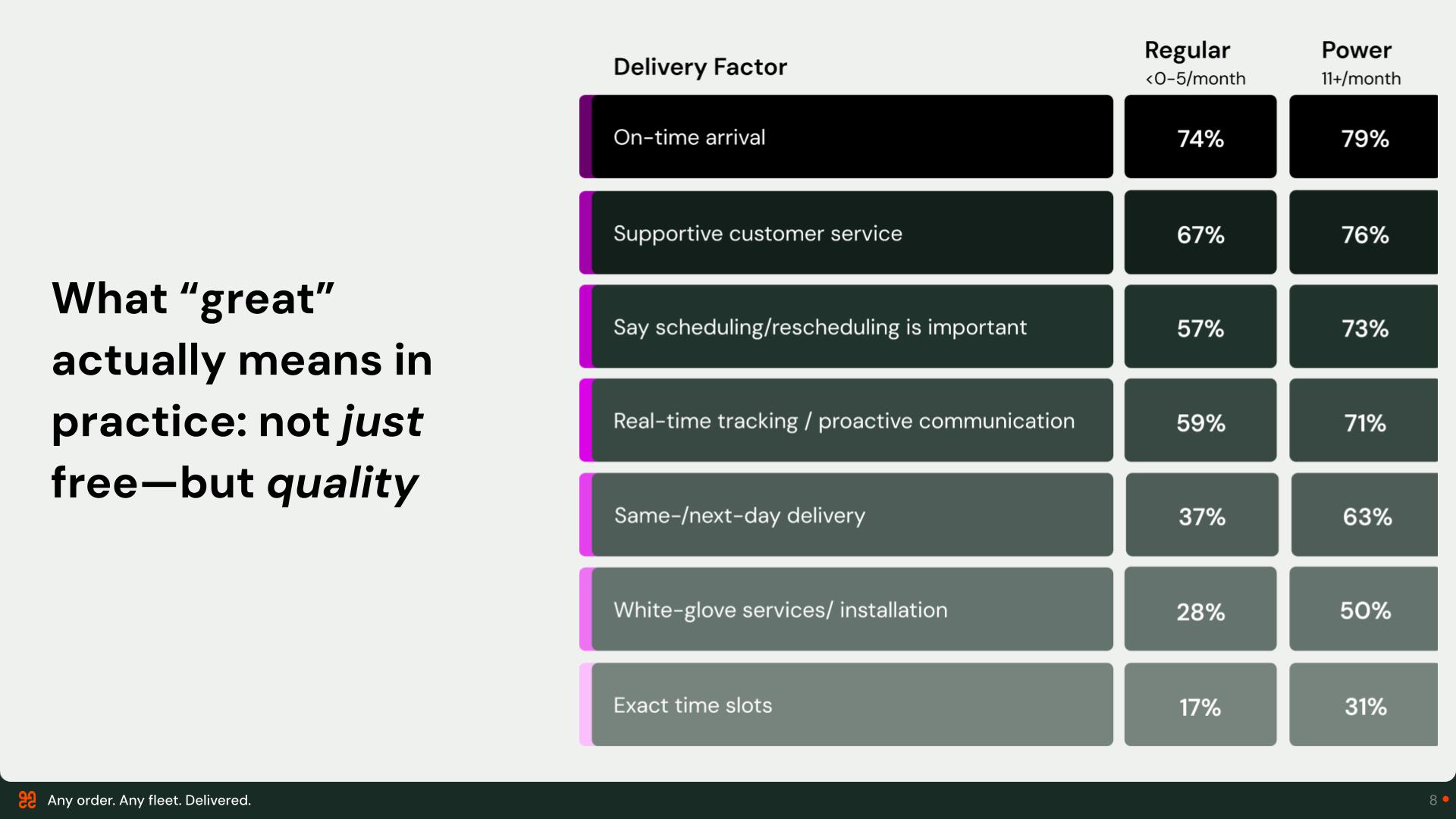
Ryan Leigh: So let's have a look at what delivery factors consumers do think about as part of that brand promise. What kind of things do they value, in the common delivery factors? What I want to do here is, kind of, as a bit of an exercise, rule out the top three things, because those top 3 things are common across all cohorts of the research, like fast and free, sorry, free shipping, obviously things arriving not broken. And having a good, solid returns policy, like, I would say these things are table stakes. Right, Morgan? We would agree on that.
I think if we look beyond that, the things we've highlighted are that for shoppers overall, in all of the cohorts, on-time arrival and responsive customer experience, they outranked speed. I want to take a pause there and let that settle in, because we've been conditioned to think that fast and free are the two things that matter most, but actually, the research shows that on-time arrival and having a good customer experience and good customer service are more important than, same or next-day delivery.
What that shows us is that quality of delivery, it's not just about speed. That becomes the differentiator for shoppers, regardless of which cohort they belong to. And actually, if we break that down further, so if we break out regular shoppers versus power shoppers, you can see the differences between what they value, what means great to them, between those that shop very, very regularly and those that shop occasionally online. But across the board, we're seeing that power shoppers have higher expectations of you as a retailer or a shipper.
So what I do want to call out, without going through every single thing on this slide, I want to call out white glove, which is second from the bottom here, and the difference between regular shoppers, where 28% of them responded that this was valuable, versus half of power shoppers saying that this was a valuable thing. That difference tells us that you can use advanced services like white glove to differentiate with those power shoppers. And the really great thing is, because they're shopping online so much more frequently, they will fuel your growth ambitions moving forwards, just because of the way they value this kind of service.
Big and bulky delivery expectations
Morgan Hass: And I love that you pointed that one out, because obviously it ties to this next slide, where we, you know, segue into big and bulky here for a minute. Also across segments, we saw that big and bulky delivery experiences are held to a much higher standard than everyday delivery. More than half say they have higher expectations for these purchases over parcel.
And I think that that makes a lot of sense. I mean, there's really an emotional component here when we think about big and bulky purchases. They're often more expensive, they require a lot more consideration, and they're difficult to coordinate. As Ryan and I were talking about the data in prep for this presentation, I thought back to all of my big and bulky deliveries throughout the years. And honestly, I have more negative delivery experiences with big and bulky than positive.
And one of my favorite ones that I reference often is when I ordered a new couch to be delivered. So not only was the original shipment delayed, so I was without a couch for over a week. It showed up, and the legs weren't with it. And so those were gonna be delayed, like, another 2 weeks or something. So, what did I do? I got on Amazon, and I bought legs, and I attached them myself. And thankfully, the couch still stands. Nobody's fallen. But I also haven't ordered from that original retailer since.
Ryan Leigh: You did your own white glove and installation services.
Morgan Hass: Yeah, I don't know if I'd give myself a 5-star review, though.
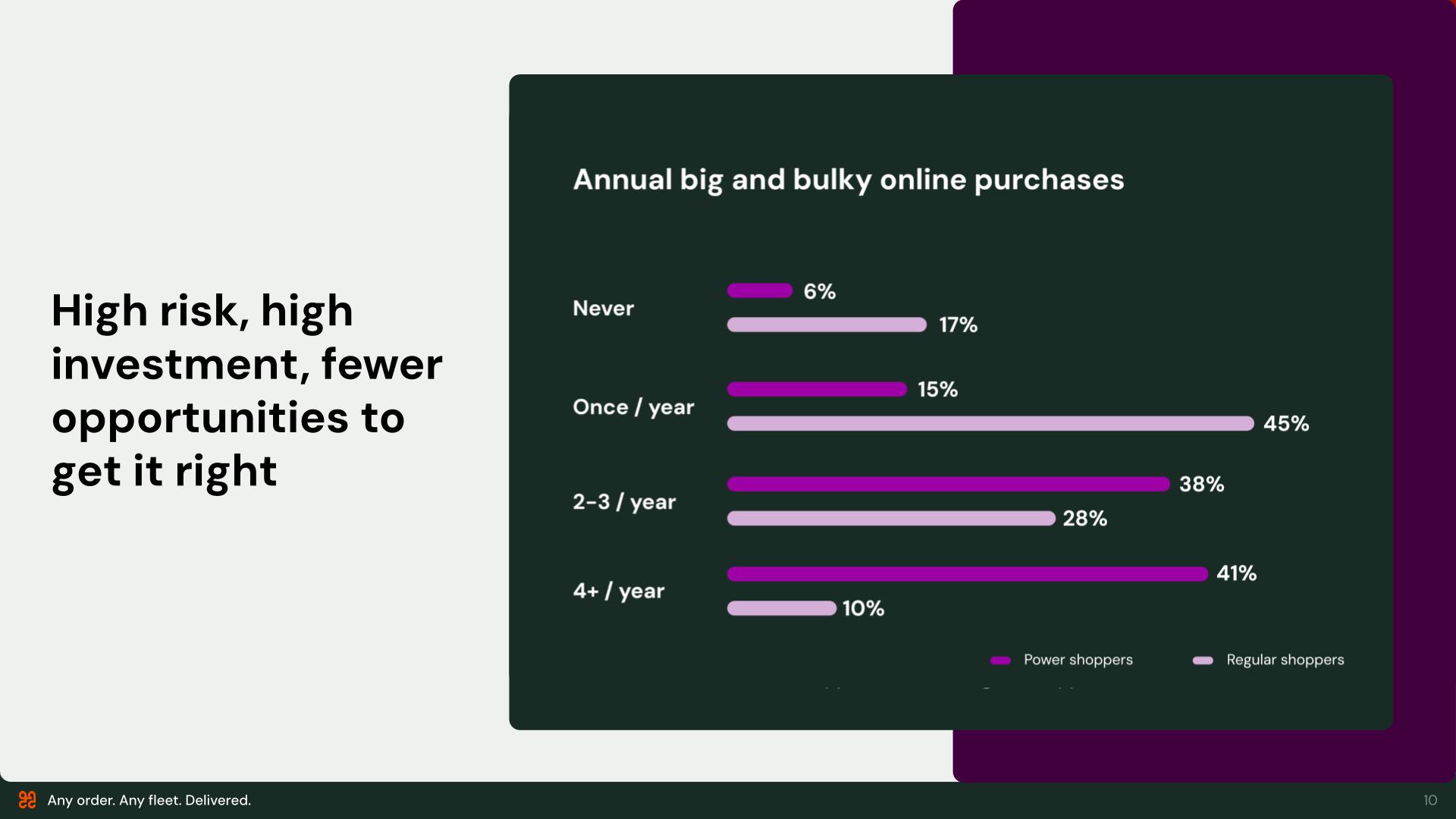
Morgan Hass: These experiences really stand out, though, because they are more infrequent. They're few and far between than the average delivery. Even for power shoppers, when we look at that cohort, these larger, more complex purchases are only happening about once a quarter, so of course they're top of mind when we recall what the delivery experience was like.
Ryan Leigh: Yeah, so what I do want to say here is that I think this graph is a little bit misleading at first, because on… on first glance, it looks like 45% of regular shoppers shopping once a year is a big percentage for you guys to aim for if you were looking at a kind of target market.
But if you look further down, so if you look at the bottom of this graph, at 4 plus times a year, the regularity of that shopping with a big and bulky purchase. You'll see that power shoppers are doing that almost four times more often than regular shoppers. So what that says to me is that if you can attract those power shoppers using the delivery factors that they value so highly that we've just been talking about, you'll actually create a much higher revenue potential with a smaller, more loyal audience, which I think is quite an interesting thing to take away from this.
Morgan Hass: Yeah, and it just shows how comfortable power shoppers are making those higher investment purchases online than everyone else.
Ryan Leigh: Understanding those expectations is one thing. Obviously, we need to look at the bigger issue, which is what happens when those expectations aren't met.
The high cost of bad delivery
Morgan Hass: Well, the data does show us that bad delivery affects future loyalty, and that it has the power to turn away customers for good. And that really stood out to me for very obvious reasons, but it's especially true for those power shoppers. Nearly 70% said that they've stopped buying from a brand solely because of delivery. These are the customers ordering most often, and they are also the least forgiving.
What's also telling is how clearly they remember it. Only 10% say they can't recall, compared to 24% of regular shoppers. So these high-value customers don't overlook bad delivery. They notice it, they remember it, and they are more willing to take their business elsewhere than anyone else.
Ryan Leigh: Yeah, so what we're looking at here is a graph around when we asked them about those negative experiences, what was it about those specifically that made them negative? And we can see an overwhelming leader here in, late… late delivery is a big culprit. But if I… if I interpret this graph, then what it tells me is that actually the… it's more likely to be the proliferation of late deliveries relative to those other types of delivery failures, that means it's the leader in terms of things they remember as a negative. Lateness is just a more common problem. Even though, if you look at other areas of the data, and we've showed some of those already today. Lateness was level with things like packaging condition and things arriving in good order in terms of importance. But here, on this chart, we're seeing that it's, by far and away the leader in terms of things that were remembered as part of the negative experience.
So I think it's just that one of, you know, just that more of our respondents have encountered this lateness and that's what brought it to top of mind. But what we can tell is that this is a killer of brand trust.
CTA: Get more insights from the discussion in the 2026 Delivery Experience Study
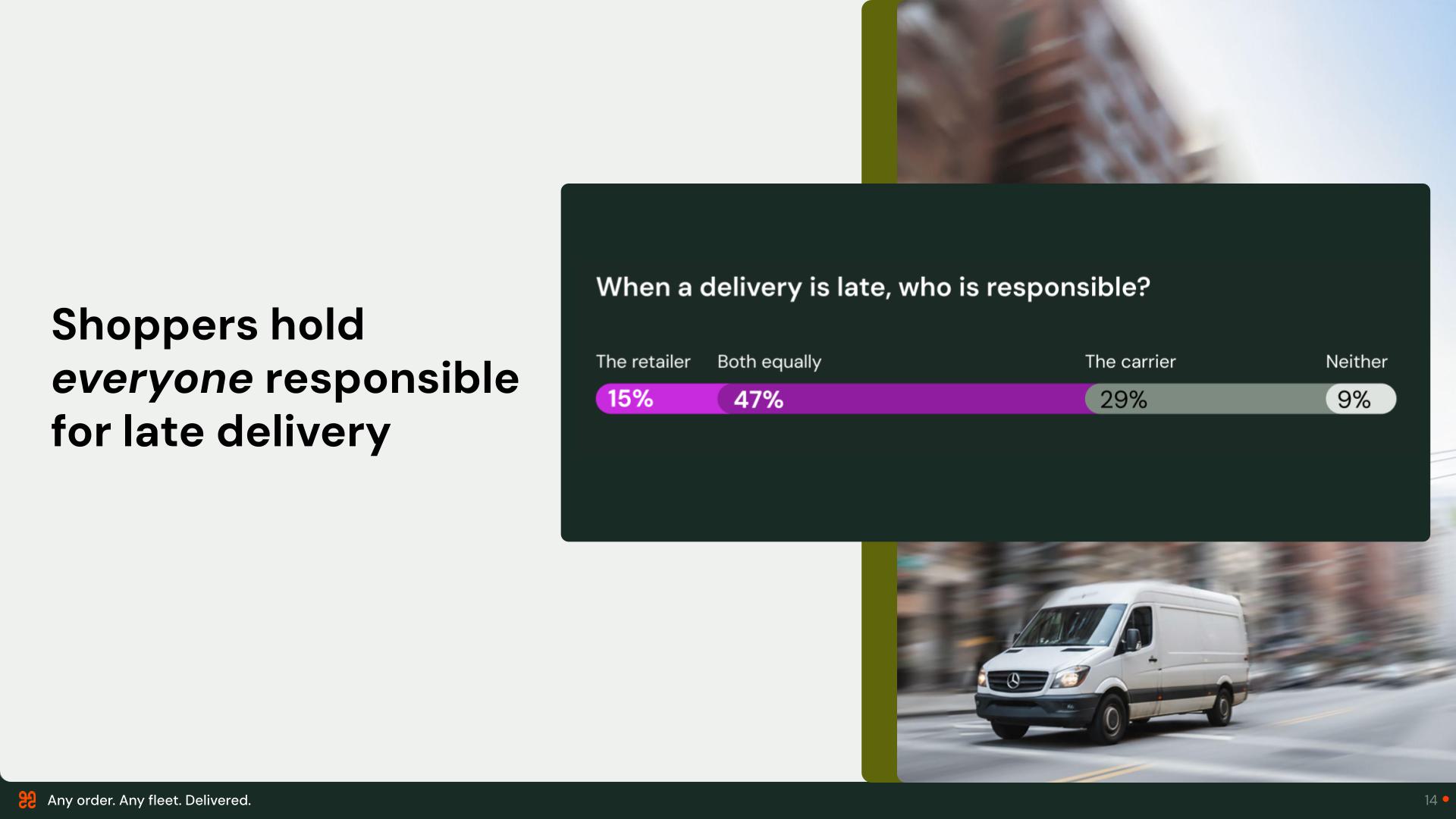
Ryan Leigh: What we're gonna do here now is dig into the blame game a little bit. So, if a delivery is late, who's responsible? And okay, yes, overall, consumers, like, if you aggregate the kind of equal distribution of blame and then the carrier, then overall carrier… consumers tend to hold the carrier more responsible for things like lateness, and that's assuming that the retailer isn't doing the delivery themselves.
But let's think about the way those consumers can express that blame moving forwards. So if we work it through, consumers don't choose the carrier, you do, if you're the retailer. The only way for the consumer to express their blame is to take it out on you, the retailer. They can't take it out on the carrier, and that means not coming back the next time. So that's a direct hit on customer lifetime value, and as we saw on the last slide, lateness is the number one reason to abandon a brand.
So, we were talking the other day about transparency, right? When I think, just to go back to an anecdote we were sharing, Morgan. And we were saying, you mentioned a couch, and I had a couple of examples that I won't go into detail on, or rather, I won't name the culprits, but those logistics companies in the UK, they know who they are. Lateness is a major problem, but I'll tell you, we would be a lot more forgiving of this if we were proactively told about the reasons that these things were happening, right? We work in logistics, we kind of know the intimate details of it.
Morgan Hass: We do, and you know, yeah, that order that we were talking about, at least on my end, it did finally show up, so I ordered a product, with expedited shipping, and 3 weeks later, I sent my first WISMO email in years. And while they did come back with a note from the founder that did feel really authentic to their brand, and I really appreciated that level of communication and thoughtfulness, it still didn't answer the fundamental question of when the package was going to arrive, and so I think being in this industry gives us unique perspectives, and yeah, maybe I'm a little more forgiving, and I especially appreciate that authenticity, so I will be buying with them, again, but it's just an interesting position to be in, and that transparency does go a long way. You know, with my couch example, there wasn't that transparency. So I think that communication is huge.
Ryan Leigh: So for me, like, I think, like, the W in Wismo needs to stand for why, not where. Like, I don't really care where my order is right now. What I want to know is why is it late? So it's kind of, like, really understanding how your operation works and being able to communicate that effectively out to your customer base is a big thing to solve.
Morgan Hass: It goes a long way, too.
Ryan Leigh: It does.
The upside of good delivery that retailers miss
Morgan Hass: But Ryan, I know I've had a couple of negative anecdotes. Let's not end on a low note. Let's end on a high note. What do you think?
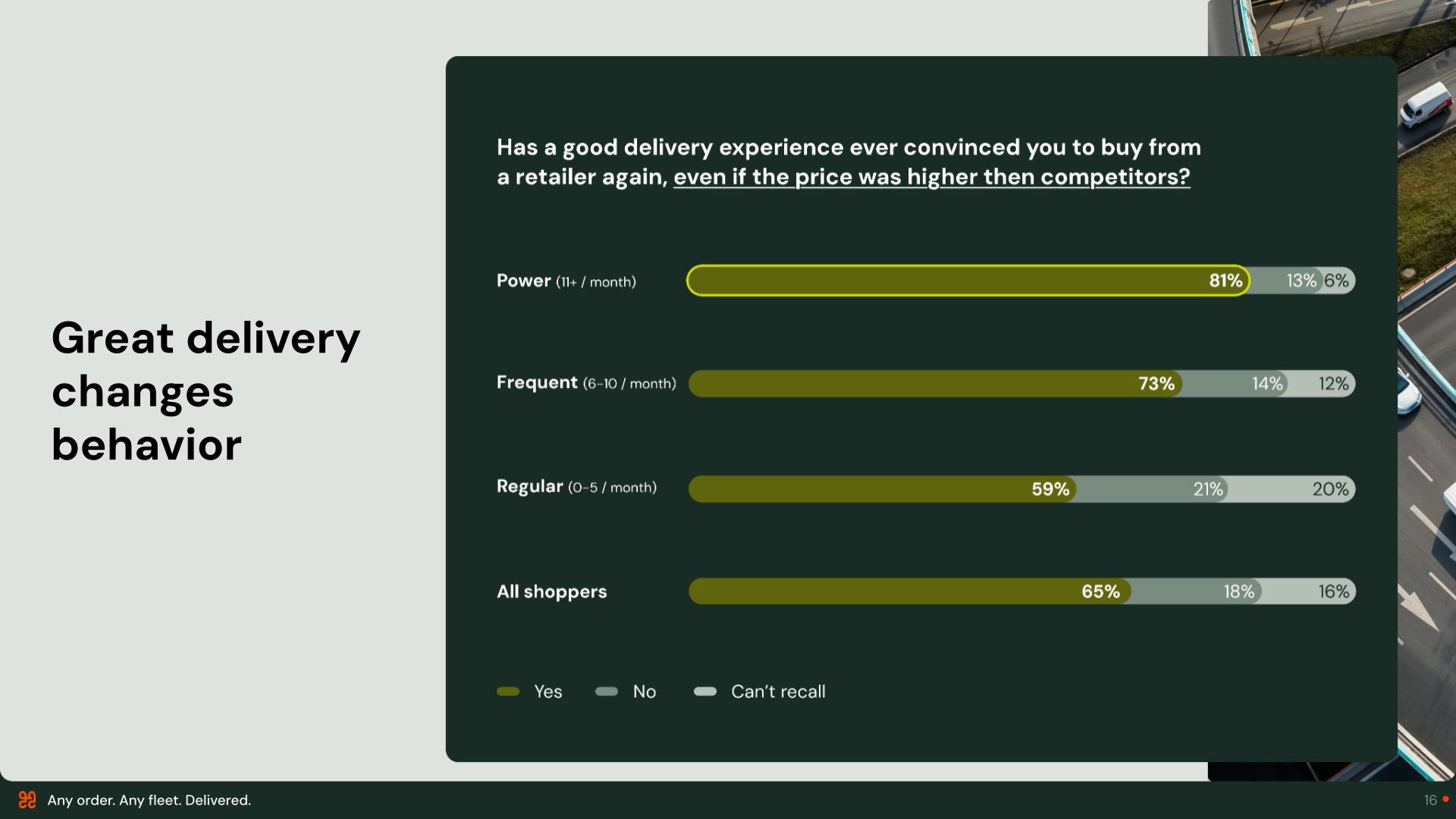
Ryan Leigh: Okay, deal. The good news is great delivery changes consumer behavior. So, when we spoke to our research audience about what made a good delivery great and when you would shop with a retailer again, even if the price was higher than the competitors. That's an important point to bear in mind here. Having a great deliver… you know, the power shoppers, really valued that great delivery experience, and it made them more likely to shop with the retailer or the brand again, even when that price was higher. So what that means is that having a great delivery experience allows you to differentiate on other things than price, which means you can protect your margins. It means you can probably justify spending a little bit more to get it right. It doesn't boil everything down to cost. And you certainly don't always have to compete on price if your last mile is in shape.
Morgan Hass: Yeah, I think what really came through for me in this data is that, we do hear about competing on price all the time, but if you're a retailer or a brand, and you've offered up that quality, that reliability, and that control, giving the control to the consumer, or proactively communicating with the consumer, that that is valued way more than price, because again, if I know I can get my goods by a specific time, or to fit my lifestyle, then I'm happy to pay a bit more to ensure that that's true.
Ryan Leigh: Yeah. And actually, one more thing to call out here, like, it's kind of small, but just look at how low that number is in the top right here of the graph. Like, 6%, only 6% of power shoppers couldn't tell us about this positive experience. Like, even compared to the bad experiences, that we spoke about earlier, that, Morgan, you mentioned, 10%. So, power shoppers remember those great deliveries. They'll trust your brand, they'll come back and shop with you again, and only 6% of them couldn't remember. And that just makes me think of all of those negative reviews, the negative stories that we've been talking about already on this call about deliveries, that we've experienced, or things we've read online about poor delivery.
I feel like we need a moment here to celebrate, you know, great deliveries online. Get out there and review companies about things that they're getting right.
Morgan Hass: Yeah, I like that. Let's spread some positivity.
Recap
Ryan Leigh: All right, so let's summarize and wrap this up, and I'm going to come back to a few of the points we've raised, and then we'll be ready to take questions. So, first off, the modern last-mile mandate. There's a real shift required here. It's a shift from just focusing on speed to thinking about things like precision. It's… it's from… it's in, kind of, looking at delivery in a different light. So, instead of thinking of it as a necessary evil, something that comes after the fact, looking at it as a way to differentiate your brand in a crowded marketplace.
And finally, you know, treating the last mile as less of a cost center and more of a way to drive loyalty amongst the cohorts that we surveyed, and in particular, the power shoppers who are really driving volume online.
And if we group this feedback into categories, so a few things for you to focus on. In terms of ideal delivery capabilities, without getting into specifics, these consumers value certainty. They… they expect you to follow through on the promises that you make, so if you take that delivery experience, you make it great, and then you put it in front of the consumer as part of your brand promise, they expect that to be, they expect to be able to depend upon that, and we've been talking about that with some of the stories we've shared today.
They also expect accuracy, so making sure that when you give visibility into your capacity to deliver something, that you do that in a way that means that you're certain that you can deliver on that promise as well.
And then we spoke a little bit about some of our experiences around transparency and communication from the brands we've dealt with, so it's about having real-time visibility that's both proactive and also accurate in terms of the way that you explain these problems, and the fact that you do that ahead of time, you don't wait for these problems to arrive, you don't wait for those WSMO calls to roll in.
Ryan Leigh: And then finally, in particular with the power shoppers, it's about having a high-end service, so it's differentiating yourselves from the competition through things like white glove or other complex types of orders. This gives you an ability to differentiate with power shoppers and earn their trust for future purchases and create, you know, long-time or high lifetime value, I should say.
Okay, so to kind of wrap this up, I would say most retail and logistics organizations are, and this goes for companies that we speak to, maybe there are some on the call here, they're at different levels of maturity, but I can say that most are still operating with yesterday's playbook. They're optimizing for speed, they're competing on shipping cost. They're treating delivery as a downstream operational problem. But the challenge is that consumers have just moved on. We can see that from the data here.
So, fast and free shipping, it hasn't disappeared, it's become the baseline. It's become the table stakes on which to enter the market, meeting that doesn't earn loyalty anymore. It just keeps you in the game. So, to truly differentiate and win, you need to put delivery front and center in your brand promise. You have to aim to attract those power shoppers that we've been talking about with value-add services. And then you have to make damn sure that you follow through on those promises when you… when you make them.
Audience Q & A
Morgan Hass: Great. Thank you, Ryan. So now we'll turn… we'll open it up for Q&A, and we've got a couple of our first questions. So, please send them through, if you've got them, and we'll try our best to get to them.
So, first question here. This is to you, Ryan. On the blame game: How can we think about that relationship between the retailers and the carriers when they're… for around late deliveries?
Ryan Leigh: So, what do you mean by how can we think about the relationship between them?
Morgan Hass: Well, I think this goes back to the slide on who's to blame for the late delivery, but it's about…Yeah, when… when… even if a carrier gets it wrong, I'm guessing, how do we think about working with carriers?
Ryan Leigh: Our experience tells us that some retailers have their own… their own team internally that are doing the delivery, and then… and then many of them are outsourcing that to a third party. So, one of the challenges of that relationship, or that setup, whilst you have the convenience of not having to manage that operation in-house, you're trading that off for a little bit of control. So I think, if I'm kind of looking at areas to give advice here, it's thinking about how you, given the data that we've seen. It's thinking about how you can hold those carriers accountable to the service levels that you've signed up to so that when you position delivery as a part of your brand promise to the consumer, you can rely on those carriers as partners, to follow through on their end of the bargain.
I think it's also about having, like, and I'm sure most retailers we talk to now are doing this, but there are still some that are single-threaded with a carrier. I think it's mitigating risk through having multiple relationships and the ability to kind of: move between those relationships when you need to, rather than having a kind of single carrier model. So I don't know if that answers the question, but happy to answer any follow-up there from the audience.
Morgan Hass: Great. Okay, next question. Are there any known challenges for big and bulky delivery on demand? Is it the higher expectations, complex delivery?
Ryan Leigh: I would say, based on my experience with our… with our customer base and the types of retailers we talk to things that I can think of off the top of my head are, first of all, making sure you've got the inventory in stock. Like, there's a lot… there are… there are many retailers we talk to that still don't necessarily have a good handle on livestock inventory within the store. And if you're going to offer an on-demand delivery service, then you need to have a high degree of confidence that what you're promising at checkout or even before then, the product page is something you can deliver, both in terms of the transport options that you have, but also in terms of the inventory availability within, you know, within a useful service area near to the customer. So, that's something to think about, making sure that you have that inventory availability under control.
The second thing is, of course, picking and staging capacity and the space to do that, so one of the challenges with big and bulky items is…staging those somewhere within a store, as opposed to a warehouse, so I'm assuming that if you're going to do an on-demand delivery model, you'll be looking to leverage a kind of physical store footprint rather than a centralized warehouse. So that means that you need to think about where do you stage those orders before the courier or the carrier have picked them up to deliver them out to the customer. That can impact on the physical shopping experience for your customers in store, so that's something to bear in mind.
And then the third thing, of course, is the type or the profile of carriers that you would likely need to use in order to service a delivery that is happening much quicker than a normal delivery. The integrations that you need to do, the variety of carriers that you might want to have available, so that you have got that confidence that when you promise something, obviously the inventory's there, the store team can cope with it, and in addition, you have a carrier available.
Morgan Hass: Great. Next question. You mentioned that people are making decisions about whether or not to shop with a brand before they even browse or get to checkout page. How should we wrap our mind around revenue we are missing out on?
Ryan Leigh: Yeah, this is a challenging one, because this is…this is data that is mostly invisible if you don't see those consumers arriving at your sales channel and then abandoning carts at checkout because of cost or speed or some other reason. The fact that they haven't even considered you for that is a kind of invisible statistic that needs to be factored in, and it is a challenge to try and find this data. But I think what we're trying to do here is show trend data from a wide-ranging piece of research that we've done that identifies particular cohorts of potential shoppers and the things that they value. And try and factor those in so that you do attract more of that traffic to your sales channels in the first place.
And the second, of course, is that there are many, many consultancies and services out there that can help you to define or redefine your total addressable market, so that you can look at ways of maximizing the volume of that market, or the percentage of that market that arrives at your sales channel in the first place.
So I think I would do a couple of things. It's kind of working with those consultancies to really understand the potential market, and then secondly, making sure that when they do put their trust in you and arrive at the sales channel, that you have a compelling offering to make sure they convert.
Morgan Hass: That’s a perfect segue to your next question for you, Ryan. So you talked about delivery choice and the checkout. Convenience is defined by the individual, of course. They may choose one delivery option for one purchase, and a different option for another purchase. Question: How many options should a retailer provide? Example, express, standard. More or less, what's appropriate?
Ryan Leigh: That is a good question. Sort of like, how long is a piece of string? I think it depends on what you're delivering. It depends on the type of goods you're trying to sell. So, there are some types of services that are more likely to require rapid turnaround.
For example, even in big and bulky, for example. Goods, you know, like a fridge freezer, or a washing machine, or whatever, that type of thing at least in my house, tends to be a bit of an emergency purchase rather than something that I plan into my annual budget, so if my washing machine is broken, I can tell you our washing's gonna be piling up pretty quickly in our house with all the kids running around and getting in the mud, so that's something that I need to replace quickly.
So, in that decision, it would probably be speed and some sort of delivery window that I would need in order to make sure that I'm buying something that is coming within the right time frame and at a time that suits me to be able to receive it at home. So, you know, within Big and Bulky, I would say that that makes sense for an emergency purchase like that. And then, obviously, in addition to that, you need to have some form of, sort of, free option, because there are still many consumers out there that value that highly, as we saw in the data. So, something that is a little bit longer in duration for those purchases that are not urgent.
And then I think a kind of named day with some sort of appointment setting capability makes sense for those that are… and again, I'm focusing on big and bulky here, because that was the theme of our webinar, so, the kind of named day with a scheduled appointment, that makes sense for, I don't know, I'm moving house and I need to get a new wardrobe delivered the day after I move in, for example.
So, I think it's about having a variety of these things for different shopping missions.
Morgan Hass: Great. What, in your opinion, is the most important last performance, or last-mile performance metric for customer experience?
Ryan Leigh: Well, see, yeah, but CSAT's a lagging indicator, so, like, a good leading indicator for success here is still OTIF. Like, if you just look at how much we were harping on about lateness, and about how that impacts consumer experience and likelihood to shop again.
So the oldies are usually the goodies. So, in this case, I think on time in full is the winning metric, particularly for those retailers that are outsourcing delivery to a carrier. Because things like deliveries per hour, or whatever those things are, operational metrics that belong with the company that are doing the delivery. So, if you're a retailer that has their own fleet, then those things have a place. They're measurements of cost metrics, but ultimately the thing that's going to guarantee you success with these consumers that we have surveyed is making sure you deliver things on time and in full.
Morgan Hass: Great. Okay, well, I think that those are the questions that we've gotten so far, so unless there are any other lingering questions, please send them through, or we can give you 5 minutes back.
But…Thank you, Ryan. Thank you to everyone who joined the webinar today. We were so happy to share these insights with you, and please follow up if there are any other questions, and we'll send that report out after… after today.
Ryan Leigh: Well, thanks for hosting me as well. No, it was great. Thank you for attending, everyone, and thanks for the questions. And, if there are any further questions, obviously feel free to get in touch with us, and we'll be sharing out the survey results shortly, I think, like you said, Morgan.
Morgan Hass: Yep. Sounds good. Alright, have a great rest of your day, everyone. Bye!
CTA: Get more insights from the discussion in the 2026 Delivery Experience Study


